A caramel color sample trial should answer a defined factory decision before anyone scales the ingredient into production. Treat it as a caramel color application test with a fixed formula, process, blank or current approved control, justified candidate range, and acceptance criteria written before results are visible. The trial then records color, uniformity, compatibility, process response, sensory impact where relevant, and change during the buyer’s planned review period. It is not a generic proof that one caramel color suits every food. It is a controlled comparison for one formula, one process, one package, and one target market.
Define the Decision Before the Sample Arrives
Write a one-page trial brief that names the business question. Examples include replacing an approved color, qualifying a second source, moving from liquid to powder, correcting shade variation, or testing a candidate in a new product. Keep one main question per trial. A trial that changes the color, sweetener, acid system, process temperature, package, and storage plan at the same time cannot show which change caused the result.
The brief should identify:
- candidate material, supplier, sample lot, form, and document revision;
- target food, formula revision, process line or laboratory simulation, and pack;
- destination market and intended labeling review owner;
- current approved control or blank;
- buyer-defined response variables and acceptance criteria;
- trial owner, observers, decision date, and escalation path.
Confirm that the sample is eligible for evaluation. QA should reconcile its identity with the supplier records, while regulatory staff check the intended market and food category. The European Commission food-additive rules, for example, separate specifications from authorization conditions. A successful color trial does not override a failed regulatory or document review.
Build a Control and Sample Matrix
Use controls that make the result interpretable. A blank shows the base formula without the candidate color. The current approved material shows the appearance and process response the plant already accepts. When a replacement is being considered, include both if practical. Code samples so the evaluation team does not make assumptions from the supplier name, especially during visual or sensory review.
Select trial points from the buyer’s approved objective, candidate documentation, prior experience, and preliminary bench work. Do not copy a public dosage into a production formula. A useful matrix may include a lower point, a working point, and an upper point around a technically justified reference, but the actual levels must belong to the buyer’s formula and regulatory review.
| Trial arm | Purpose | Variable allowed | What remains fixed |
|---|
| Blank | Establish the formula’s natural color and background haze | No caramel color | Formula, process, pack, observation time |
| Current approved control | Show the accepted production reference | Approved color system | Same batch of base, process and pack |
| Candidate low point | Test whether the candidate reaches the lower visual target | Candidate addition level | Sample lot, addition method, process |
| Candidate working point | Test the planned working condition | Candidate addition level | All other formula and process variables |
| Candidate upper point | Check response and compatibility near the upper justified range | Candidate addition level | All other trial conditions |
Randomize or balance the evaluation order when visual differences are subtle. Prepare enough replicate units to separate a real effect from mixing or measurement noise. The site should set replicate count from risk, variability, equipment capability, and decision importance; there is no universal number for every product.
Prepare and Add Each Sample Consistently
Record the actual weight, sample condition, balance ID where required, preparation vessel, diluent or premix, addition order, mixing time, mixing speed or equipment setting, and hold time before use. Use one preparation method for all candidate points unless the method itself is the variable under study. If liquid and powder forms require different preparation, treat form and preparation as controlled factors rather than hiding them in one comparison.
Color measurements depend on standardized preparation. The FAO/JECFA caramel-colour monograph, for example, defines a specific sample concentration, solids basis, path length, and wavelength for its color-intensity method. That official analytical method is not a production recipe, but it demonstrates why a number is meaningless without its preparation and measurement basis.
Prevent avoidable trial error:
- Bring the base and samples to the defined condition before weighing.
- Use calibrated or verified equipment appropriate to the amount.
- Add in the recorded order and avoid material left on the vessel wall or tool.
- Use the same mixing endpoint for every arm.
- Label every vessel immediately with the coded treatment, preparation time, and operator.
- Record deviations when a sample foams, settles, clings, forms lumps, or requires unexpected rework.
If caramel color powder must first enter a wet system, follow a separate controlled reconstitution procedure. That process belongs to the powder-dispersion guide, not to an improvised step inside this general trial.
Reproduce the Real Process, Not Just the Recipe
A bench trial should model the operations that may influence the buyer’s decision. Record shear, sequence, temperature history, holding time, concentration or dilution, cooling, filling, and the time between preparation and evaluation. Use scaled equipment only after deciding which process features must remain comparable. A beaker that reaches the same final formula but skips a high-solids cook or long hold may not represent the plant.
Map the process into checkpoints. Observe the candidate after initial addition, after the critical heat or shear step, after cooling or dilution, at filling, and during the buyer’s defined storage review. Not every project needs every checkpoint. Choose the points that can identify when an unacceptable change begins.
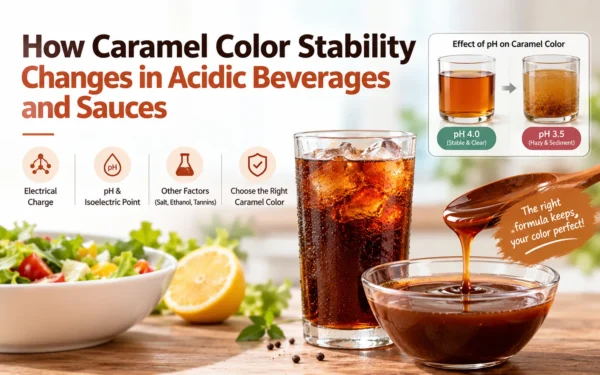
For acidic products, watch clarity and sediment as well as color. Do not assume a caramel-color class will behave identically in every acid, protein, salt, alcohol, or flavor system. The separate guide to caramel color stability in acidic systems owns detailed acid-failure troubleshooting. Here, the rule is to reproduce the actual formula and keep those variables controlled.
When the formula or process cannot be simulated credibly in the laboratory, state the limitation and move the decision to a pilot with suitable safeguards. A false sense of precision from an unrealistic bench method is less useful than a clearly bounded preliminary screen.
Evaluate Color, Compatibility, and Finished-Product Impact
Decide how the team will judge each response before unblinding the codes. Visual panels should use controlled lighting, backgrounds, containers, sample depth, and timing. Instrumental color or absorbance data require defined sample preparation, instrument settings, path length, blank, and reporting units. A supplier value and a finished-food measurement may answer different questions, so do not compare them without a method bridge.
Use a response sheet that links each observation to a decision:
| Response | Observation or method | Buyer decision |
|---|
| Target appearance | Approved visual standard, image standard, or instrumental target | Does the trial meet the intended shade and depth? |
| Uniformity | Top, middle, bottom, or multiple units after the defined process | Is mixing and distribution acceptable? |
| Clarity or separation | Haze, ring, sediment, flocculation, or phase separation at defined times | Is the candidate compatible with this formula and process? |
| Process behavior | Addition, mixing, heating, cooling, filling and line observations | Can the process control the ingredient without unplanned rework? |
| Sensory impact | Qualified panel or project-specific check where relevant | Is any color-linked taste or aroma change acceptable? |
| Retained appearance | Buyer-defined package, condition and review points | Does the appearance remain within the project criterion? |
Supplier technical references may list color strength, pH, hue, haze, salt stability or application-specific tests. The Sethness Roquette FAQ is one industry example. Use such information to ask better questions, not to assume another supplier’s method, range, or product performance applies to the candidate.
Set Laboratory, Pilot, and Plant Gates
Separate screening from approval. The laboratory gate removes unsuitable treatments and identifies the smallest defensible pilot matrix. The pilot gate checks process scale, addition practicality, mixing, equipment interaction, fill consistency, and short-term finished-product response. The plant gate confirms the approved formula and work instruction under authorized production controls.
Before each gate, name the evidence required to proceed:
- all critical acceptance criteria pass or have an authorized, documented rationale;
- deviations and unexplained observations are closed or assigned;
- the selected level and addition method are traceable to the sample lot and formula revision;
- regulatory and label reviews are complete for the intended market;
- the next scale has a defined batch size, equipment, sampling plan, and stop rule;
- production, QA, R&D, procurement, and regulatory responsibilities are clear.
A pass at one scale does not guarantee a pass at the next. Change only what the scale requires, retain the control where possible, and record the reason for any revised process condition. If the pilot changes the selected level or addition method, update the trial record rather than treating the laboratory choice as final.
Close the Trial With a Reusable Decision Record
The report should allow another qualified person to understand what was tested and why the team decided. Include the objective, approved protocol, raw-material and sample lots, formula version, coded matrix, actual additions, preparation records, process conditions, observations, raw data, images under controlled conditions where used, deviations, statistical or practical interpretation, and signatures or electronic approvals.
State the outcome precisely: rejected, hold for more evidence, accepted for pilot, accepted for a defined product/process, or approved through formal change control. Avoid broad conclusions such as suitable for sauces when the trial covered one sauce formula. Record open risks, monitoring needs, supplier questions, and any conditions that must be added to the material or process specification.
Before building the matrix, use the general selection guide to choose a candidate class and the four-class guide when the team needs classification background. Those resources help identify a candidate; the controlled trial determines whether it meets the defined formula, process, package, and market criteria.
A good formulation trial does not produce a universal claim. It produces a traceable answer for a named formula, process, package, market, and acceptance plan. That evidence becomes part of caramel color validation for the named application rather than proof for every food. Discuss your caramel-color application and controlled trial requirements with our technical team.