The search phrase “soy sauce powder gluten free” should be treated as a documentation question, not as a product claim. For a soy sauce powder purchase, an allergen or gluten question should be handled as a documented supplier-and-factory review, not answered from a product name, color, or informal sales message. Start with the exact material, sample lot, intended market, and finished-food claim. Then obtain the current ingredient statement, allergen declaration, cross-contact information, and change-control process before deciding whether the material is suitable for your formula.
Separate soy, gluten, and cross-contact questions
These are related but different review questions. Soy is an ingredient source that must be considered in an allergen review. Gluten status concerns the presence or absence of relevant gluten-containing grain sources and the substantiation required for any finished-product claim. Cross-contact concerns whether an unintended allergen could enter a material or finished food through shared equipment, handling, rework, dust, or labeling error.
For U.S.-bound packaged foods, the FDA identifies nine major food allergens, including soybeans, and explains that manufacturers need controls to prevent allergen cross-contact and undeclared allergens. Read the current FDA food-allergy information alongside the rules and customer requirements that apply to your destination market. This article is a purchasing checklist, not a regulatory determination or a product claim.
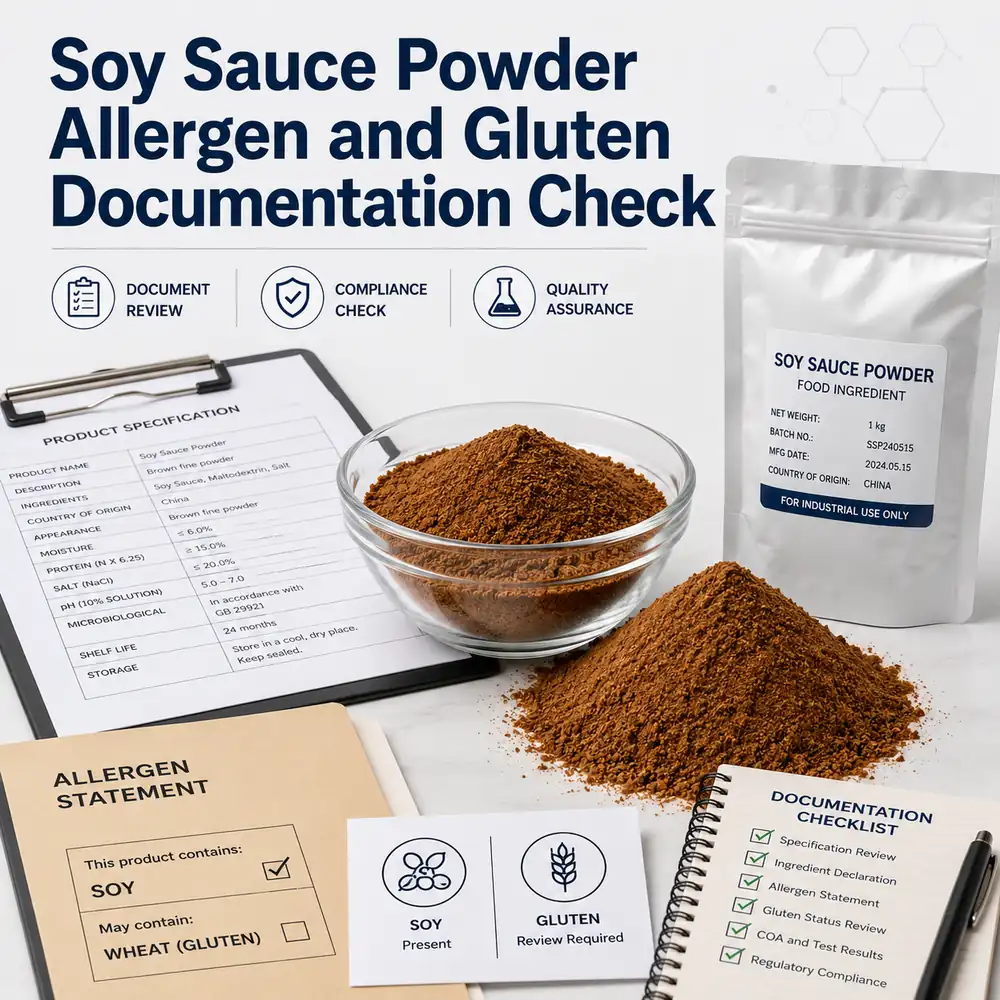
A soy sauce powder allergen review needs a current gluten documentation file and a dated cross-contact declaration for the exact material or production scope under review. These documents inform the factory’s decision; they do not replace a destination-market assessment of a finished-food claim.
Do not assume a soy sauce powder is gluten-free
A product containing “soy sauce” in its name should never be assigned a gluten status by assumption. The manufacturing route, declared ingredients, carrier system, flavor components, shared-line controls, and destination-market requirements all need review. Likewise, the absence of a gluten-containing ingredient on an informal list does not by itself substantiate a finished-product “gluten-free” claim.
The FDA notes that it has a defined standard for use of the “gluten-free” label in the United States, including specific compliance considerations for fermented or hydrolyzed foods or foods containing those ingredients. A buyer should therefore ask the responsible regulatory team to review the final claim and evidence package rather than copying a supplier’s general marketing phrase onto a finished-food label.
This distinction matters when a manufacturer is purchasing a flavor ingredient for instant noodles, snack coatings, dry seasoning blends, or prepared foods. The use case may be different, but the evidence standard should remain controlled and traceable.
Request an allergen-and-gluten evidence pack before sampling
Before a sample is released to R&D, request documents that identify the exact product and revision. A useful evidence pack normally includes:
- a current ingredient statement for the supplied material;
- a formal allergen declaration that states what is intentionally present;
- a cross-contact or shared-facility statement, with its scope and date;
- any gluten-related declaration offered by the supplier, including its product scope;
- the latest technical specification and a COA linked to the sample lot;
- a written change-notification process for ingredients, sources, processing, site, and documents.
Keep original files, dates, revision numbers, and supplier contacts in your approved-supplier record. If the documents use vague phrases such as “allergen free,” “may contain,” or “tested,” ask what the statement covers and how it is controlled. Do not translate vague wording into a stronger finished-product claim.
Use a review matrix that assigns a clear owner to every gap
| Control point | Evidence to collect | Internal owner | Decision if incomplete |
|---|
| Intentional allergens | Ingredient statement and allergen declaration | QA / regulatory | Hold label and formula approval |
| Cross-contact exposure | Supplier control statement and site scope | QA / supplier quality | Request clarification or reject for claim-sensitive use |
| Gluten-related claim | Claim-supporting documentation for the exact material | Regulatory / customer compliance | Do not make the claim |
| Lot traceability | COA, sample label, and specification revision | QA / purchasing | Hold sample result from approval decision |
| Supplier change control | Written notification commitment | Purchasing / supplier quality | Escalate before commercial release |
Review the finished formula, not only the purchased ingredient
A supplier document describes the ingredient supplied to your factory. It does not replace the review of your finished recipe, other ingredients, shared production environment, packaging process, or finished label. If your product will carry an allergen or “free-from” claim, build a cross-functional check that includes the formula owner, QA, regulatory, purchasing, and the customer team where relevant.
Consider the complete material flow: receiving, storage, weighing, blending, transfer, rework, cleaning, packaging, and label verification. The practical controls required will depend on your facility and market. The FDA describes allergen preventive controls as including measures to prevent cross-contact in manufacturing and packaging and to prevent undeclared allergens; that does not mean a generic supplier declaration alone is adequate evidence for every factory’s finished product.
Test only against a written purpose and method—and control changes
Testing can be part of a verification plan, but it does not solve an undefined question. Before sending a sample to a laboratory or running a pilot, state what the result is meant to support, which sample is being tested, which method will be used, who interprets the result, and how it relates to the finished product. For claim-sensitive products, agree the evidence plan with the responsible regulatory or customer-compliance team before purchase.
A formulation trial can still provide valuable process evidence: it may identify handling, segregation, labeling, or change-control questions that are not obvious in a data sheet. For broader product-use context, see applications of dehydrated soy sauce powder in food processing and soy sauce powder for seasoning manufacturers.
Allergen and gluten reviews are only reliable if the supplier notifies the buyer before relevant changes take effect. Ask what triggers notification: a formula change, a new ingredient source, a production-site move, a shared-line change, an allergen-control change, a document revision, or a packaging change. Make that notification process part of the approved-supplier record rather than a verbal assurance.
At receiving, verify that the delivered product matches the approved name, revision, lot documentation, and packaging identification. When a change is reported, place the material back into review before it is used in a formula or claim program that depends on its prior status.
Choose an approval status that reflects the evidence
Use three simple outcomes. Approve for the stated use when the exact material is documented, the evidence fits the intended market and formula, and internal owners have signed off. Hold when a fact is unknown, the scope of a declaration is unclear, or a change-control commitment is missing. Reject or re-source when the evidence does not fit the required product or claim.
For general supplier evaluation steps, you can also use sample testing when evaluating a soy sauce powder supplier. The important boundary is that neither this checklist nor a supplier’s broad statement establishes a Qianhe product’s allergen, gluten, or certification status. Those facts must come from current, product-specific documents.