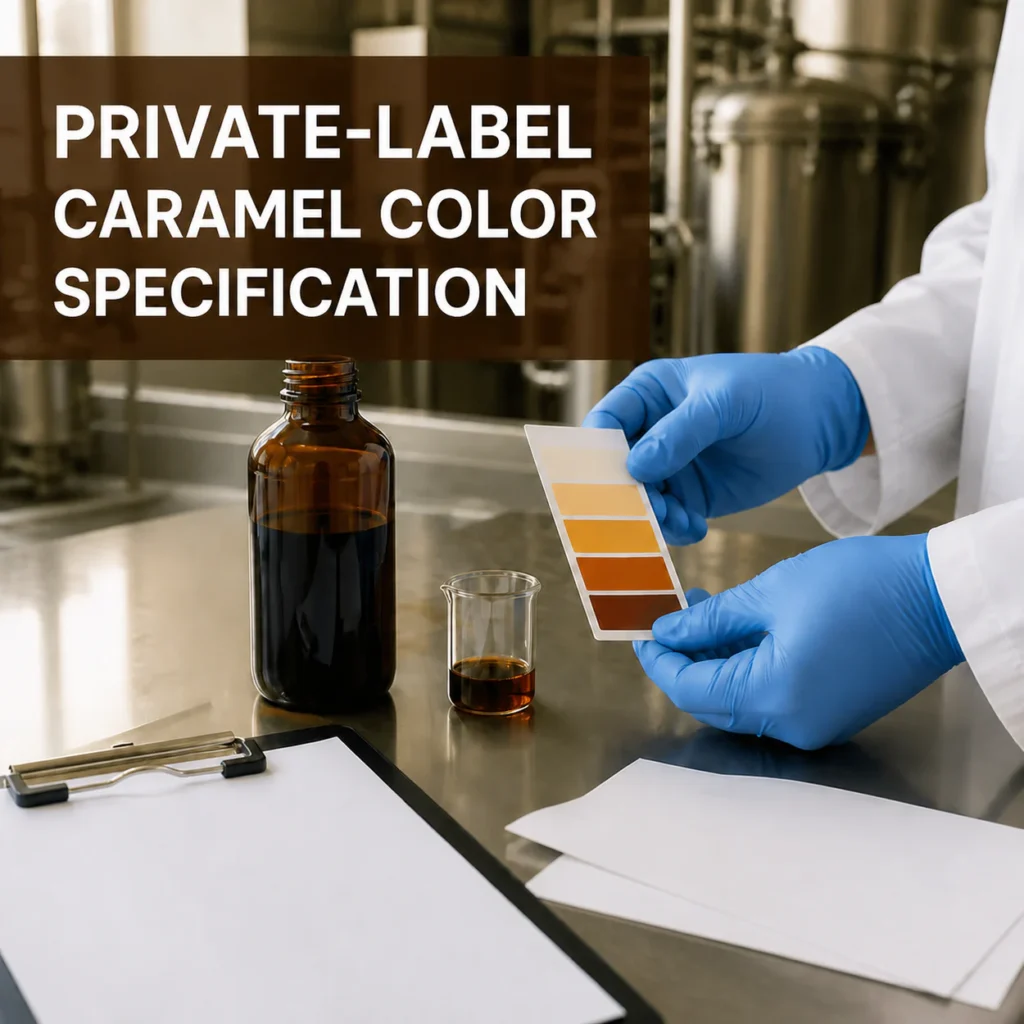
A private-label food project needs more than a product name and a target brown shade. Before a caramel color is approved, the brand owner, food factory and ingredient supplier need the same written definition of what will be supplied, how it will be evaluated, which documents will travel with each lot, and what happens if something changes. That definition is the caramel color specification.
A good specification reduces ambiguity before the first commercial delivery. It is not a copy of a brochure, and it is not a legal conclusion about every destination market. It is a controlled purchasing document that connects the finished food, the supplier’s material and the factory’s release process.
Begin with the finished product requirement
Start the specification with the private-label product, not with a generic ingredient description. Identify the finished food category, the desired visual standard, target markets, pack format and the manufacturing process. A caramel color for a sauce, beverage or dry seasoning may need different trial questions, even when the project team uses the same supplier.
The written brief should capture:
- finished product name, category and intended consumer market;
- the approved colour reference or target shade;
- formula conditions that may affect appearance, such as pH, salt, proteins, hydrocolloids or acids;
- key process stages, including mixing, heating, filtering and filling where relevant;
- the expected dosage-development range rather than a single unexplained number; and
- the owner of technical approval, quality release and regulatory review.
This creates a clear boundary between a general caramel color product overview and the material actually selected for a particular private-label formula.
Separate product identity from performance requirements
The first part of the specification should make the supplied material unmistakable. State the approved material name, physical format, supplier name, internal code, intended application and current document revision. If the project needs a particular caramel color class, describe that requirement in a way that can be checked against the supplier’s current documents and the destination-market review.
The next part should set out the performance questions that matter to the factory. Do not write vague phrases such as “good quality” or “stable.” Define how the team will judge the material and in which food system. For background on the different caramel color classes, see Caramel Color Class I–IV Explained; the finished-product trial must still establish suitability for the actual recipe.
| Specification section | What to define | Why the private-label team needs it |
|---|
| Material identity | Product name, format, supplier code, approved revision and intended application. | Prevents purchasing a similarly named but unapproved material. |
| Colour performance | How colour intensity and hue will be assessed in the finished product or agreed trial method. | Keeps shade decisions linked to the brand reference, not a bottle-only comparison. |
| Process fit | Relevant pH, salt, heat, mixing, filtration and addition-point checks. | Creates a testable link between the ingredient and factory process. |
| Documentation | TDS, COA format, lot identity, ingredient information, handling information and market-review needs. | Supports receiving, traceability and customer file review. |
| Change control | Which changes require advance notice and reapproval. | Protects the private-label formula from silent substitutions. |
Write testable colour and process criteria
Colour intensity and hue should be judged by an agreed method. The specification can state the reference product, required dilution basis for comparison, lighting or instrument method, and the person or department responsible for approval. If the supplier reports a color value, record the method and basis alongside it. A number without conditions is difficult to compare between documents or batches.
Include the process conditions that the sample must pass. For example, the private-label factory may need to check appearance after normal mixing, after heat treatment, after a filtration step or after a defined storage check. The goal is not to promise that a material will behave the same in every formula; the goal is to ensure the approved result is tested in the formula that will be manufactured.
Define the document package before purchase order release
Private-label projects often delay at the document stage because commercial and technical teams requested different information. List the required document package in the specification and assign an owner to check each item. A practical package can include a current technical data sheet, a COA format, lot traceability information, ingredient or composition information appropriate to the review, handling guidance and any customer-requested statements.
For regulatory questions, name the destination markets and instruct the responsible team to verify applicable requirements for the finished food. Sources such as the Codex General Standard for Food Additives database and the EU additives database are useful starting points for formal review. They do not replace a market-specific legal, labeling or customer assessment.
Add lot-release and traceability instructions
A specification becomes operational only when receiving and quality teams can use it. State what must match when a lot arrives: purchase order, product name or code, supplier lot, container label and COA. Clarify who releases the lot, which deviations require escalation and how retained samples or records are stored. This prevents a technical specification from sitting in a folder while the factory relies on visual judgment alone.
Make change control explicit
Private-label food manufacturing depends on controlled repeatability. The specification should require advance notice of material, manufacturing-site, document-revision, packaging, test-method or other changes that could affect the approved product. It should also state whether a new sample, document review, bench trial or line trial is needed before a changed material is used.
For a wider factory procedure, see the related guidance on working with a caramel color manufacturer and discuss the proposed control points with your quality and procurement teams. The final document should be approved by the people who will use it, rather than being written only by one department.
A short specification template
- Project: private-label finished food, market and factory site.
- Approved material: material name, supplier code, physical format and use scope.
- Performance check: reference shade, trial method, process stages and acceptance owner.
- Required documents: TDS, COA, lot traceability, handling and destination-market review inputs.
- Receiving release: identity checks, deviation path and record retention.
- Change control: events requiring supplier notice and customer reapproval.
Frequently asked questions
Is a supplier brochure a sufficient private-label specification?
No. A brochure may be useful background, but it rarely defines the finished-food process, color reference, lot-release documents or approval path needed by a private-label project.
Who should approve the specification?
At minimum, include the people responsible for formulation or product development, quality release, purchasing and the customer or brand owner’s relevant technical review.
Should one specification cover every food application?
Not usually. Use a common supplier document package where appropriate, but keep application-specific process and performance criteria tied to the finished food.
Next step: turn your current private-label brief into a one-page specification draft, then request matching sample and document information through Qianhe’s contact page.