Caramel Color in Sauces: Applications, Stability, and Formulation Guide
Featured Snippet: Caramel color is widely used in sauces to improve brown color, batch consistency, and product appearance. In soy sauce, BBQ sauce, gravy, marinades, and seasoning sauces, the right caramel color helps maintain stable color during processing, heating, storage, and large-scale production.
Introduction
Color is one of the first quality signals consumers notice in sauce products.
Before tasting a sauce, buyers often judge it by appearance. A deep brown soy sauce, a glossy BBQ sauce, or a rich gravy can suggest stronger flavor, better consistency, and higher product quality.
This is why caramel color is widely used in sauce manufacturing.
In sauce applications, caramel color is not simply added to make a product darker. It helps manufacturers control color consistency, reduce batch variation, improve shelf appearance, and maintain stable visual quality during processing and storage.
For food manufacturers, sauce brands, importers, and private label buyers, understanding how caramel color works in sauces is important for product development and supplier selection.
1. What Is Caramel Color?
Caramel color is a food colorant produced by the controlled heating of food-grade carbohydrates.
Common carbohydrate sources may include:
- Glucose
- Sucrose
- Invert sugar
- Molasses
- Starch hydrolysates
Unlike caramel candy or dessert caramel sauce, caramel color is mainly used for coloring performance rather than sweetness or flavor.
It can create a wide range of brown shades, including light amber, golden brown, reddish brown, dark brown, and black-brown.
In food labeling, caramel color may appear as caramel color, caramel coloring, E150, E150a, E150b, E150c, or E150d.
For a broader explanation of different caramel color types, you can also read this guide on Caramel Color Class I-IV.
2. Why Caramel Color Is Used in Sauces
Sauces are complex food systems. Their color can be affected by raw materials, fermentation, cooking temperature, pH, salt level, spices, sugars, proteins, and storage conditions.
Color Standardization
Natural ingredients often vary between batches. Soybeans, wheat, spices, vinegar, sugar, and fermented raw materials can all influence the final color of a sauce. Caramel color helps manufacturers maintain a more consistent appearance.
Stronger Visual Appeal
Many sauces are expected to have a rich brown appearance. A sauce that looks too pale may be perceived as weak, diluted, or less flavorful. Caramel color can help create a deeper and more appetizing visual profile.
Processing Stability
Many sauces go through heating, pasteurization, hot filling, retort processing, or long storage. The right caramel color can help maintain stable color during these processes.
Formula Flexibility
Caramel color allows manufacturers to adjust appearance without heavily changing the base formula. This is useful when a brand needs to keep flavor, viscosity, salt level, or cost structure stable while improving color.
3. Main Sauce Applications of Caramel Color
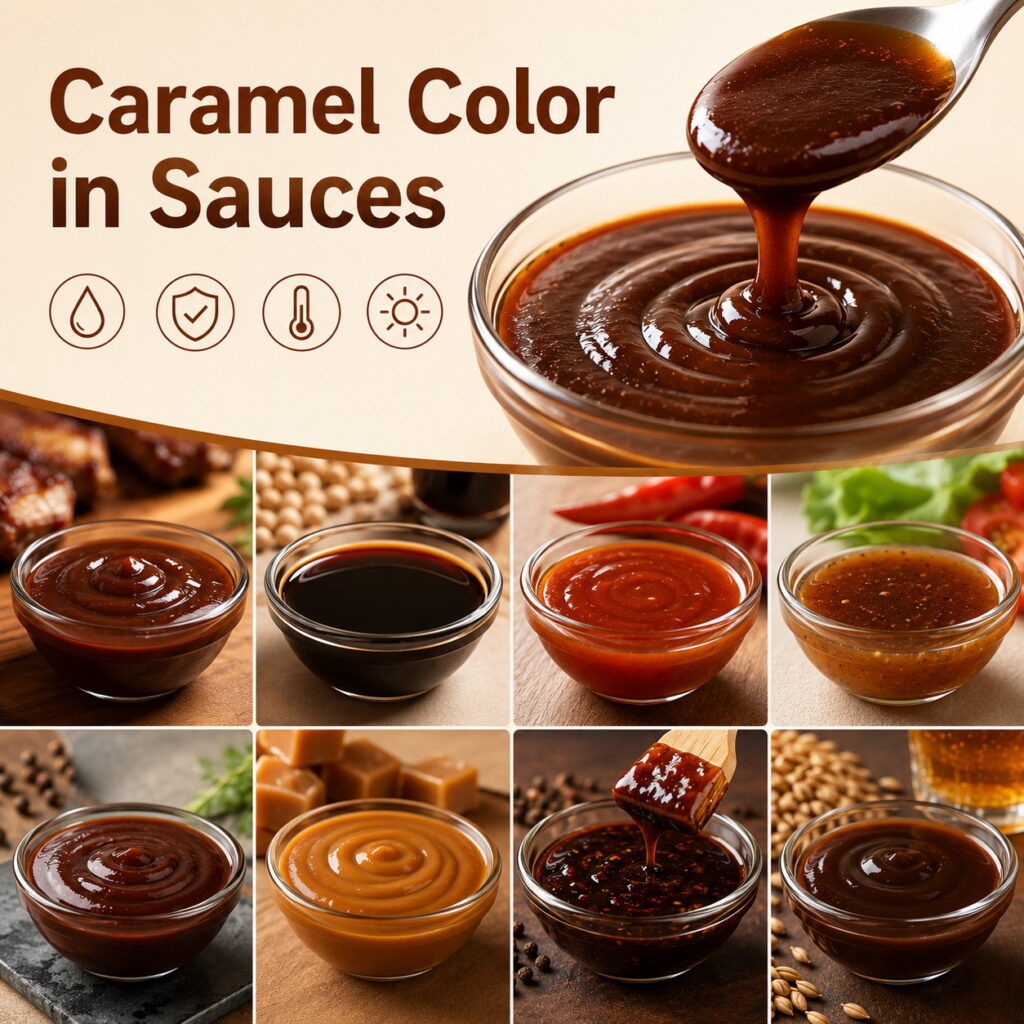
Soy Sauce
Soy sauce is one of the most important sauce applications for caramel color. In soy sauce products, caramel color can help adjust the final brown tone and improve visual consistency.
Common applications include:
- Dark soy sauce
- Mushroom soy sauce
- Cooking soy sauce
- Compound soy sauce
- Food service soy sauce
- Private label soy sauce
For soy sauce, caramel color must perform well in a high-salt system. It should remain stable during storage and should not cause sediment, haze, or separation.
The goal is not simply to make soy sauce darker. Dark soy sauce usually needs deeper color and better coating appearance, while light soy sauce should remain clear and reddish-brown.
BBQ Sauce
BBQ sauce often requires a deep reddish-brown or dark brown color. Caramel color can support the appearance of roasted, grilled, or smoky flavor notes.
It also helps maintain consistent color when tomato paste, sugar, vinegar, spices, and smoke flavor vary between batches.
Gravy and Brown Sauce
Gravy and brown sauce rely heavily on visual richness. Consumers often associate a deeper brown color with roasted meat, cooked stock, and savory flavor depth.
In these applications, caramel color helps create a stable brown appearance even when the formula contains starch, proteins, fats, or thickening agents.
Marinades and Seasoning Sauces
Marinades need both appearance and coating performance. A good marinade should give meat, seafood, or vegetables an appealing color before and after cooking.
Caramel color may be used in teriyaki marinade, steak marinade, roasted meat sauce, stir-fry sauce, seasoning sauce, and braising sauce.
For seasoning and sauce applications, Qianhe provides caramel color solutions for different condiment formulas.
Vinegar-Based and Acidic Sauces
Some sauces contain vinegar, tomato paste, fruit acids, or other acidic ingredients. Examples include Worcestershire-style sauce, steak sauce, vinegar-based BBQ sauce, sweet and sour sauce, and some salad dressings.
For acidic sauces, the selected caramel color should have good acid stability. Otherwise, the product may develop haze, sediment, color shift, or separation during storage.
4. Which Type of Caramel Color Is Suitable for Sauces?
Caramel color is commonly divided into four classes.
| Type | Common Name | Sauce Application Relevance |
|---|
| E150a | Plain caramel | Suitable for some simple applications, but usually lower color strength |
| E150b | Sulfite caramel | Used in selected food and beverage systems |
| E150c | Ammonia caramel | Often suitable for high-salt sauces, soy sauce, gravy, and savory sauces |
| E150d | Sulfite ammonia caramel | Often used in acidic sauces and dark-colored products requiring strong stability |
For sauce manufacturing, E150c and E150d are often the most relevant types.
E150c is commonly considered for savory sauce systems where salt tolerance and dark brown color are important. E150d is often selected for products requiring strong color intensity and stability, especially in acidic systems.
For a deeper explanation, read this article on what type of caramel color E150d belongs to.
5. Key Technical Factors in Sauce Formulation
Choosing caramel color for sauces requires more than matching a shade card. The colorant must be tested in the actual sauce formula.
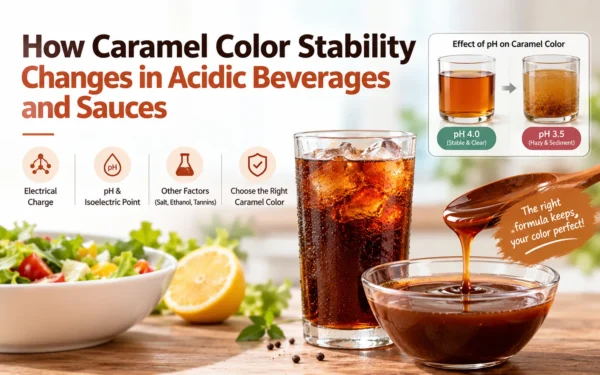
pH Stability
Sauces may be acidic, neutral, or salt-rich. If the caramel color is not suitable for the pH environment, the sauce may show haze, sediment, color fading, color shift, or separation.
Salt Tolerance
Soy sauce and many seasoning sauces contain high salt. The selected caramel color must remain stable in high-salt conditions.
Heat Stability
Many sauces are heated during production, including cooking, pasteurization, hot filling, retort treatment, or UHT processing. A suitable caramel color should maintain stable appearance after heat treatment.
Color Strength
Color strength determines how much caramel color is needed to reach the target shade. Higher color strength can help reduce dosage and minimize impact on flavor or formula balance.
Flavor Impact
Although caramel color is mainly used for color, some types may contribute mild roasted, bitter, or burnt notes at higher dosage. For delicate sauces, manufacturers should choose a caramel color with low flavor impact.
Ingredient Compatibility
Sauces often contain salt, vinegar, sugar, starch, gums, proteins, spices, oils, preservatives, and flavor enhancers. Caramel color should be evaluated in the full formula, not only in water.
6. How Caramel Color Improves Soy Sauce Products
Soy sauce is a color-sensitive product. Consumers often associate soy sauce color with flavor strength, brewing quality, and cooking performance.
Caramel color can help soy sauce manufacturers achieve a stable and market-appropriate appearance.
In Dark Soy Sauce
Dark soy sauce usually requires a deeper brown color and stronger coating effect. Caramel color can help improve surface color on food, visual depth, cooking appearance, and batch consistency.
In Cooking Soy Sauce
Cooking soy sauce may be exposed to heating, stir-frying, braising, or steaming. Color stability after heat exposure is important.
In Food Service Soy Sauce
Food service buyers often require large-volume supply with consistent appearance. Caramel color helps reduce batch-to-batch color variation.
In Private Label Soy Sauce
Private label buyers usually have fixed color standards. Caramel color allows manufacturers to match specific customer requirements more accurately.
For brands developing soy sauce products, working with an experienced soy sauce manufacturer can help align color, flavor, packaging, and documentation requirements.
7. Formulation Reference: How to Apply Caramel Color in Sauce Products
When caramel color is used in sauce manufacturing, the selection should be based on the sauce system rather than color shade alone. Different sauces have different requirements for pH stability, salt tolerance, heat resistance, color strength, and flavor impact.
According to FDA 21 CFR 73.85, caramel color is produced by the controlled heat treatment of food-grade carbohydrates such as dextrose, invert sugar, lactose, malt syrup, molasses, starch hydrolysates, and sucrose. The regulation also states that caramel may be used for coloring foods generally in amounts consistent with good manufacturing practice, unless a specific food standard restricts added color.
For sauce manufacturers, this means caramel color should be added at the lowest effective level required to achieve the target appearance, while maintaining formula stability and meeting local regulatory requirements.
Recommended Selection Logic for Sauce Applications
| Sauce Type | Formula Characteristics | Suggested Direction | Key Test Points |
|---|
| Soy sauce / dark soy sauce | High salt, fermented flavor, brown to dark brown appearance | E150c or salt-tolerant caramel color systems are commonly considered | Salt stability, sediment, color depth, heat stability, flavor impact |
| BBQ sauce | Acidic, sweet, thick, often heated or hot-filled | E150d or acid-stable caramel color systems are commonly considered | Acid stability, glaze color, heat stability, storage color shift |
| Gravy / brown sauce | Starch, protein, fat, savory base | E150c or E150d depending on pH and processing conditions | Haze, sediment, viscosity compatibility, cooked color |
| Marinades / seasoning sauces | Salt, sugar, spices, acid, possible heat exposure | Choose based on pH, salt level, and target brown shade | Coating color, heat performance, flavor balance, separation |
| Vinegar-based sauces | Low pH, acid-rich formula | Acid-stable caramel color, often E150d-type systems | pH stability, precipitation, fading, storage stability |
Practical Trial Dosage Recommendation
Because caramel color products differ in color strength, solids content, hue, and charge, there is no universal dosage that fits all sauces. A practical lab trial should compare several addition levels in the actual sauce formula.
For initial screening, sauce manufacturers may test caramel color at the following finished-product addition levels:
- 0.02%
- 0.05%
- 0.10%
- 0.20%
- 0.30%
These levels should be treated as formulation trial points, not fixed usage recommendations. The final dosage should be determined by target color, caramel color strength, local regulations, and sensory evaluation.
Evaluation Method for Sauce Formulation
During application testing, manufacturers should evaluate both visual performance and formula stability.
- Initial color: compare the sauce against the target color standard immediately after mixing.
- Heat stability: test color after cooking, pasteurization, hot filling, or other actual processing conditions.
- Storage stability: observe color change, haze, sediment, and separation during normal and accelerated storage.
- pH compatibility: check whether the caramel color remains stable in acidic or neutral sauce systems.
- Salt compatibility: confirm stability in high-salt products such as soy sauce or seasoning sauce.
- Flavor impact: check whether the selected dosage introduces bitterness, burnt notes, or unwanted roasted flavor.
- Labeling review: confirm additive declaration, E-number, or ingredient naming requirements in the target market.
For high-salt sauces such as soy sauce, salt tolerance should be prioritized before color strength. For acidic sauces such as BBQ sauce, steak sauce, or vinegar-based sauce, acid stability should be prioritized. For thick sauces such as gravy or marinades, the color should be tested after full hydration of starches, gums, proteins, and seasonings.
Data reference: FDA 21 CFR 73.85 defines caramel color, permitted carbohydrate sources, specifications, and general use under good manufacturing practice. International classification systems identify caramel colors as E150a, E150b, E150c, and E150d, with different technical properties and application suitability.
References: FDA 21 CFR 73.85 Caramel; Caramel Color Class I-IV Explained; What Type of Caramel Color Does E150d Belong To?
8. Common Problems When Using Caramel Color in Sauces
Sediment
Sediment may appear when caramel color is not compatible with salt, acid, proteins, or other ingredients.
Haze
Clear or semi-clear sauces may become cloudy if the caramel color is unstable in the formula.
Color Shift
The sauce may become too red, too yellow, too dark, or dull after processing or storage.
Fading
Some formulas may lose color intensity over time, especially under heat, light, or acidic conditions.
Flavor Interference
Excessive dosage may bring unwanted bitterness or burnt notes.
Labeling or Compliance Issues
Different markets may have different requirements for caramel color declaration, permitted use, and supporting documentation.
9. Documentation Buyers Should Request
For B2B sauce buyers, caramel color is not only a formula issue. It is also a compliance and supply chain issue.
Before purchasing sauces containing caramel color, buyers should request:
- Product specification
- Ingredient list
- Additive declaration
- COA
- Allergen statement
- GMO statement if needed
- Heavy metal compliance
- 4-MEI information if required
- Halal certificate if needed
- Kosher certificate if needed
- Country-specific regulatory compliance documents
For importers and private label buyers, documentation is especially important because additive labeling rules may vary by market.
10. Caramel Color vs Natural Browning in Sauces
Some sauces develop brown color naturally through fermentation, cooking, roasting, or Maillard reaction. However, natural browning can vary depending on raw materials and processing conditions.
Caramel color does not replace good formulation or quality ingredients. Instead, it helps manufacturers control final appearance more accurately.
In industrial sauce production, the goal is consistency.
Caramel color can support stable product appearance, more predictable color control, better shelf presentation, reduced batch variation, and easier private label standardization.
For more background on how caramel color works in food systems, you may also read The Role of Caramel Color in Food.
FAQ
Is caramel color used in sauces?
Yes. Caramel color is widely used in sauces such as soy sauce, BBQ sauce, gravy, marinades, brown sauce, and seasoning sauces to improve brown color, batch consistency, and processing stability.
What type of caramel color is used in soy sauce?
E150c and E150d are often considered for soy sauce and savory sauce applications, depending on salt level, pH, heat treatment, target shade, and local regulations.
Is caramel color suitable for high-salt sauces?
Some caramel color types are suitable for high-salt sauce systems, but compatibility testing is important. Soy sauce and seasoning sauces should be tested for haze, sediment, color shift, and storage stability.
Does caramel color affect sauce flavor?
Caramel color is mainly used for color, but some types may have mild roasted, bitter, or burnt notes at high dosage. Sauce manufacturers should test different dosage levels in the final formula.
Why is caramel color added to BBQ sauce?
Caramel color helps BBQ sauce achieve a deeper brown appearance, more consistent glaze color, and better visual appeal during storage and cooking.
Is E150d suitable for acidic sauces?
E150d is often selected for acidic systems because it has strong color intensity and good acid stability. It may be suitable for BBQ sauce, steak sauce, Worcestershire-style sauce, and acidic marinades.
What documents should bulk sauce buyers request?
Bulk sauce buyers should request product specifications, COA, ingredient declaration, allergen statement, compliance documents, and 4-MEI information if required by the target market.
Need Caramel Color for Sauce Manufacturing?
Qianhe provides caramel color solutions for sauce manufacturing, including liquid and powder options for soy sauce, vinegar, compound seasonings, marinades, and other food applications.
For sauce manufacturers and private label buyers, Qianhe can support:
- Product specification
- Sample testing
- Formula application guidance
- Stable batch supply
- Export documentation
- Food safety certification support
Conclusion
Caramel color plays an important role in sauce manufacturing.
In soy sauce, BBQ sauce, gravy, marinades, brown sauce, and seasoning sauces, it helps improve color consistency, processing stability, and product appearance.
However, choosing the right caramel color depends on the sauce system.
Manufacturers should consider pH, salt level, heat treatment, color strength, flavor impact, ingredient compatibility, and regulatory requirements.
For B2B buyers, the best approach is to work with a supplier that understands both sauce formulation and international compliance.
A well-selected caramel color can make sauce products look more consistent, more appealing, and better suited for large-scale commercial markets.
Note: Caramel color selection and labeling requirements may vary by market. Always confirm product specifications, compliance documents, and local food regulations before commercial use.