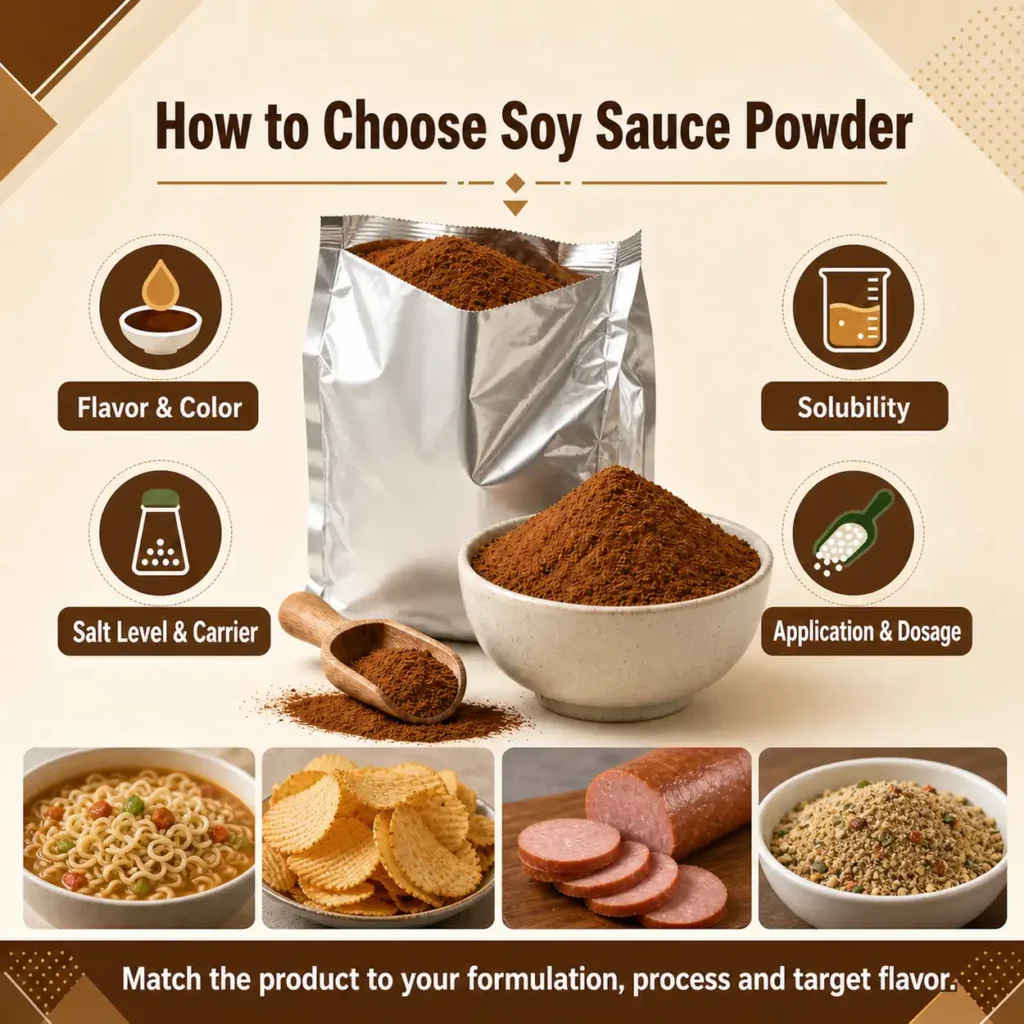
Soy sauce powder is used in snack seasonings, instant noodle soup bases, compound seasonings and meat products. Each application needs a different flavor, particle size, salt level and solubility.
Start with the food application. Then review the specification, request a sample and test it in the real formula.
Start with the Finished Food Application
Before requesting a sample, tell the supplier where and how the soy sauce powder will be used. This helps the supplier recommend a suitable model.
Snack Seasonings and Dry Coatings
For chips, crackers, rice snacks and extruded snacks, check whether the powder spreads evenly on the surface. Also check particle size, dust, adhesion to oil and any dark or salty spots.
Instant Noodles, Soup Bases and Bouillon
For products prepared with hot water, check dissolution, sediment, soup color and aroma. Test the powder in the complete formula because salt, fat, starch and other ingredients can affect the result.
Compound Seasonings and Savory Premixes
Check blend uniformity, salt contribution, flowability and storage stability. If the particle size is very different from the other ingredients, the blend may separate or cake.
Meat Products, Sauces and Ready Meals
Test the sample through the actual mixing and heating process. Judge the aroma, color and salt level in the cooked product, not only in water.
Eight Factors to Check on a Soy Sauce Powder
Do not choose a product from one specification value. Check the following eight points together.
| Factor | Why It Matters | What to Request or Test |
|---|
| Soy Sauce Base | The base sauce affects aroma, color and overall flavor. | Ask whether it is made from brewed soy sauce and check the ingredient list. |
| Flavor Profile | Products with similar salt levels can still taste different. | Compare samples at the same dosage in the finished food. |
| Salt Contribution | The powder affects the salt balance of the full formula. | Check the NaCl value and recalculate the formula before replacement. |
| Carrier Ingredients | Carriers affect flow, stability, flavor strength and labeling. | Confirm maltodextrin, salt, sugar, MSG, yeast extract and other added ingredients. |
| Particle Behavior | Particle size affects dust, separation, dosing and surface coverage. | Check feeding, mixing and dust during a production trial. |
| Solubility | A water-soluble powder may still form lumps in a full formula. | Test the actual water temperature, mixing time and ingredient order. |
| Storage Stability | Moisture can cause caking and dosing problems. | Check packaging, storage conditions, shelf life and performance after opening. |
| Allergens and Compliance | Soy sauce commonly contains soy and wheat. Market rules also differ. | Request allergen information, specification, COA and required certificates. |
Swipe horizontally to view the complete table.
Technical note: Amino acid nitrogen and total nitrogen can help compare products, but the final decision should still be based on an application test.
Fine Powder or Granulated Soy Sauce?
Fine spray-dried powder mixes easily with other dry ingredients and gives even flavor distribution. It may create more dust during handling.
Granulated soy sauce powder can reduce dust and may flow better on some lines. However, larger particles may dissolve more slowly or separate from finer ingredients.
When a Fine Powder May Fit Better
- You need uniform dry blending.
- The powder must cover a snack surface evenly.
- Your dosing and dust-control system can handle fine powder.
- The product needs fast flavor release.
When a Granulated Option May Fit Better
- You need to reduce dust on the filling line.
- Flowability is a key production concern.
- The granule size matches the other ingredients.
- Application testing confirms acceptable dissolution.
Review the Ingredient List and Allergen Position
Soy sauce powder is not always a single-ingredient product. It may contain brewed soy sauce, maltodextrin, salt, sugar or flavor enhancers. Check the full ingredient list instead of relying on the product name.
Your choice should also match the label plan for the finished food. A short ingredient list and a stronger standardized flavor may require different products.
Documents to Confirm Before a Long Trial
- Full ingredient list and recommended label name
- Soy and wheat allergen statement
- Gluten-free documents, if required
- Added MSG or yeast extract information
- GMO or non-GMO documents
- Halal, Kosher or other required certificates
- Specification sheet and recent COA
- Documents required for the destination market
Qianhe can provide available product specifications, COAs and certification documents for review. Please confirm the exact documents required for your market before starting a long trial.
How to Test a Soy Sauce Powder Sample
A water test is useful for initial screening, but it is not enough for final approval. Test the sample in the real formula and process.
1. Check the Sample and Documents
Check the appearance, aroma, flow, lumps and package condition. Confirm that the sample code matches the specification and COA.
2. Compare at Equal Dosage
Test the control and candidate samples at the same dosage. Keep water, salt and other flavor ingredients unchanged.
3. Reproduce the Real Process
Use the planned ingredient order, mixing time, heating and rehydration method. Record dust, lumps, sediment and color change.
4. Review the Product After Storage
Check the dry blend and finished food again after storage. Look for caking, flavor loss, color change and packaging problems.
What to Record on the Test Sheet
- Soy sauce aroma and aftertaste
- Umami strength and salt level
- Color in the dry blend and finished food
- Dosing, dust and blend uniformity
- Solubility, lumps and sediment
- Performance after heating or rehydration
- Caking after opening
Questions to Ask a Soy Sauce Powder Supplier
A suitable sample is only one part of the decision. Confirm the commercial and technical details before final approval.
- Which model fits this application, and why?
- Can you provide a specification and recent COA?
- What particle sizes and packaging options are available?
- What is the MOQ for standard and customized products?
- Can flavor, color, salt level or packaging be adjusted?
- What are the sample and production lead times?
- Which allergen and certification documents are available?
- How do you control batch consistency?
- What are the storage conditions and shelf life?
- Which export documents can you provide?
When requesting a sample, share the food application, target flavor, salt requirement, trial quantity, destination market, required certificates and estimated order volume.
Common Buying Mistakes
Choosing Only by Price per Kilogram
A lower price does not show the required dosage, flavor strength or processing loss. Compare the ingredient cost in the finished formula.
Approving Only a Water Solution
A powder may taste good in water but perform poorly in an oily seasoning, a high-salt blend or a heated food. Approve it in the real application.
Leaving Compliance Until the End
Confirm allergens, certificates and market requirements before a long trial.
Conclusion
The right soy sauce powder is the one that works well in your product and process. Start with the application, check the specification and documents, and then run a sample test.
Qianhe supplies soy sauce powder for seasoning blends, instant noodles, savory snacks, soup bases, meat products and other food applications. Visit the Qianhe soy sauce powder page to request specifications or samples.
Frequently Asked Questions (FAQ)
Q1: Is soy sauce powder simply dehydrated soy sauce?
It starts with soy sauce, but spray-dried products usually contain a carrier such as maltodextrin. Some products also contain added salt or other ingredients. Check the full ingredient list.
Q2: Which specification shows the strongest umami flavor?
Nitrogen values can help compare products, but no single value shows the complete flavor. Test the sample in the finished formula.
Q3: How should soy sauce powder be tested for instant noodles?
Test it in the complete seasoning packet at the planned dosage. Use the real hot-water preparation method and check dissolution, sediment, soup color, aroma and salt level.
Q4: Can soy sauce powder be used in gluten-free food?
Some soy sauce powders contain wheat. Ask for the latest allergen statement, specification and gluten-free documents required for your market.
Q5: Why does soy sauce powder cake after opening?
Soy sauce powder absorbs moisture from the air. Keep the package sealed, control storage humidity and follow the supplier's storage instructions.
Q6: What information should I send when requesting a sample?
Send the application, target flavor or dosage, salt requirement, destination market, required certificates, sample quantity and estimated order volume.