Soy sauce powder solubility should be evaluated as an application-specific reconstitution test, not accepted from a generic supplier statement. A food manufacturer needs to define the finished product, powder concentration, water phase, temperature, mixing method, addition order and endpoint before comparing samples. The result should distinguish wetting, dispersion, visible lumps, sediment and finished-system performance. That creates evidence for a specific formula and process; it does not prove that the same powder will behave identically in every beverage, sauce, soup, seasoning or dry-blend application.
Define What “Soluble” Must Mean in Your Process
In a procurement discussion, soluble can hide several different observations. A powder may wet rapidly but leave sediment. It may disperse under one mixing method but form lumps when added through a different route. It may look uniform in water and still interact differently once salt, starch, oil, protein or other ingredients are present. Treating these outcomes as one pass/fail word makes supplier comparisons unreliable.
Start by naming the commercial purpose of the test. Are you making a liquid seasoning base, a sauce, an instant soup, a snack coating slurry or a premix that will be hydrated later? The answer determines the relevant endpoint. For a factory, the useful question is: “Can this specific grade achieve our documented reconstitution and finished-product criteria in the process we intend to run?”
The existing food-processing applications guide can help identify likely application systems, but a stated application is not a proof of solubility in a buyer’s formula.
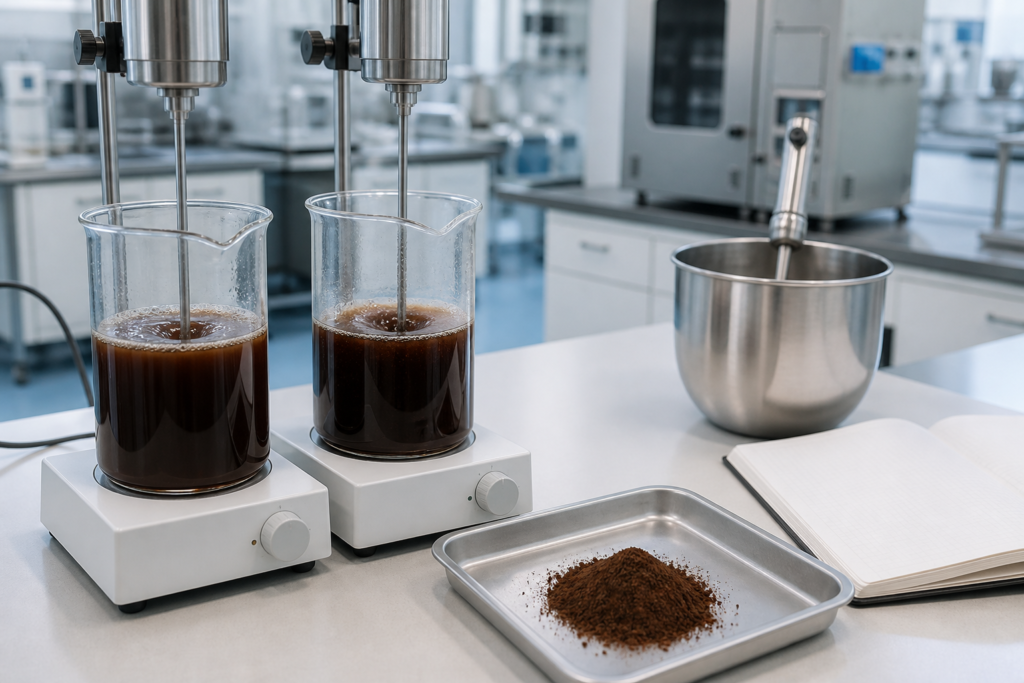
A soy sauce powder reconstitution protocol should record powder dispersibility separately from the final dissolution endpoint. A food factory sample test is useful only when its water, concentration, mixing and observation conditions are recorded well enough for the result to be repeated.
Build a Reconstitution Protocol Before Opening the Sample
Write the protocol before any sample is mixed. This prevents a favourable one-off demonstration from becoming the assumed product standard. Include the product code, sample lot, packaging condition, formula version and every main variable that can affect the observation. The method should be simple enough to repeat by another trained operator.
| Method element | What to define | Why it matters | Record to retain |
|---|
| Formula | Powder concentration and all other ingredients | Matrix composition can change hydration behaviour | Approved formula revision |
| Water phase | Water source and starting condition | Water composition may affect comparability | Water description and batch record |
| Process | Addition order, mixing equipment and mixing route | Wetting and dispersion depend on how powder enters the system | Setup, operator and timed observations |
| Endpoint | Visual, screen, sediment, sensory or process criterion | “Dissolved” must have a shared meaning | Pass, hold or reject decision and supporting observations |
Do not import a fixed mix ratio, water temperature or mixing time from a different product sheet unless it has been validated for your own formula. A supplier recommendation may be a useful starting point, but it should be labelled as a recommendation until the buyer’s test closes the question.
Separate Wetting, Dispersion, Dissolution and Sediment
A structured trial observes each stage rather than jumping to a single conclusion:
- Wetting: Does powder remain on the surface, float, clump or enter the liquid consistently?
- Dispersion: Does mixing distribute particles through the system, or are there visible non-uniform zones?
- Dissolution or integration: Does the defined endpoint for the product system occur under the documented process?
- Sediment and stability: Does the product remain within the agreed appearance or performance criteria over the relevant observation period?
Drying and formulation can influence the physical properties that affect rehydration. A review of food-powder rehydration in the Journal of Food Engineering explains why wetting, dispersion and dissolution are related but distinct phenomena. Its findings help design questions and measurements; they do not establish a performance claim for an untested soy sauce powder.
Check Ingredients and Carriers as Part of the Technical Review
“Soy sauce powder” is a commercial product name, not a complete ingredient statement. Ask for the current formula or ingredient declaration, the purpose of any carrier, the technical specification and the lot-specific COA. Carriers and processing choices can alter handling and hydration behaviour, which is why they should be reviewed alongside flavour and label requirements.
A study of spray-dried food systems in CyTA – Journal of Food describes how formulation choices can influence properties of dried powders. It is not evidence that any particular carrier will improve or impair a Qianhe product. The buyer should use it as a reason to test declared candidates under the actual formula rather than infer performance from a general category name.
Do not approve an undisclosed formula simply because a trial sample looked acceptable. Ensure the commercial grade, document revision and sample tested are linked. If the product formulation or carrier changes after approval, assess whether the reconstitution test must be repeated.
Use a Comparator and a Clear Test Sequence
Where possible, test the candidate against the current approved ingredient, a retained reference or another technically justified control. Keep the same formula, batch scale, equipment and evaluation route. If the trial needs to investigate a failure, change one main variable at a time so that the record can explain what caused the difference.
A useful sequence is:
- check the sample label, lot, pack condition and current documents;
- prepare the baseline process exactly as written;
- record wetting and initial dispersion at predefined observation points;
- evaluate the agreed endpoint, including visible lumps, screen result or sediment criterion where relevant;
- evaluate the finished system under the conditions that matter to the application; and
- retain a traceable record, photograph or sample where the factory procedure allows it.
Do not make an automatic supplier ranking from one result. A powder that does not meet a cold-process application may still be suitable for a different, documented process. Conversely, a laboratory result should not be described as proof of full-scale factory performance until scale-up evidence exists.
Interpret Failures Without Inventing a Root Cause
If a sample forms lumps, leaves sediment or misses the appearance target, start with the record rather than an assumption. Check the material identity, sample age, packaging condition, actual formula, water phase, addition order, mixing equipment and test endpoint. Then decide which factor should be investigated next.
Possible questions include whether the product was introduced too quickly for the chosen process, whether another component changed the liquid matrix, whether the test has an unrealistic endpoint, or whether a different grade is required. These are investigation paths—not diagnoses. Only comparative evidence can establish the cause in a specific application.
This distinction is commercially important. It stops a buyer from treating “does not dissolve” as a universal material defect when the real issue may be an undocumented process difference. It also stops a supplier from treating a favourable glass-beaker test as evidence of plant performance.
Turn Reconstitution Evidence into a Supplier-Qualification Decision
Combine the reconstitution record with documents that support controlled supply: current TDS, representative COA, ingredient and allergen declarations, pack description, storage statement and change-notification route. The soy sauce powder selection guide provides a broader procurement framework; this article owns the narrow reconstitution test within that framework.
Use one of three evidence-led outcomes:
- Advance: the named grade and sample lot meet the documented criteria in the defined formula and process, subject to the next planned scale-up gate.
- Hold: performance may be promising, but a document, method, traceability or scale-up question is unresolved.
- Reject for this use: the candidate misses a predefined requirement or cannot be assessed with reliable evidence.
State the scope of the decision precisely. Approval for one soup base, sauce or seasoning system is not approval for every product. Record a requalification trigger for relevant changes in grade, ingredient statement, carrier, manufacturing site, packaging, formula, process or intended market.
For a sauce, soup, liquid marinade or other hydrated system, the trial must reflect the actual formulation and process constraints. For a dry blend, the question may be whether later hydration meets the customer’s use method, not whether the powder disappears in a preliminary cup test. For seasoning packets, account for the final user’s intended preparation method but do not convert a consumer-facing scenario into a manufacturing guarantee.
Use internal application pages to direct the right technical conversation: seasoning manufacturers, seasoning packets and food-processing applications. The technical review remains buyer-owned: it should end with evidence that the defined ingredient, formula and process work together—not a general assertion that a powder is universally soluble.