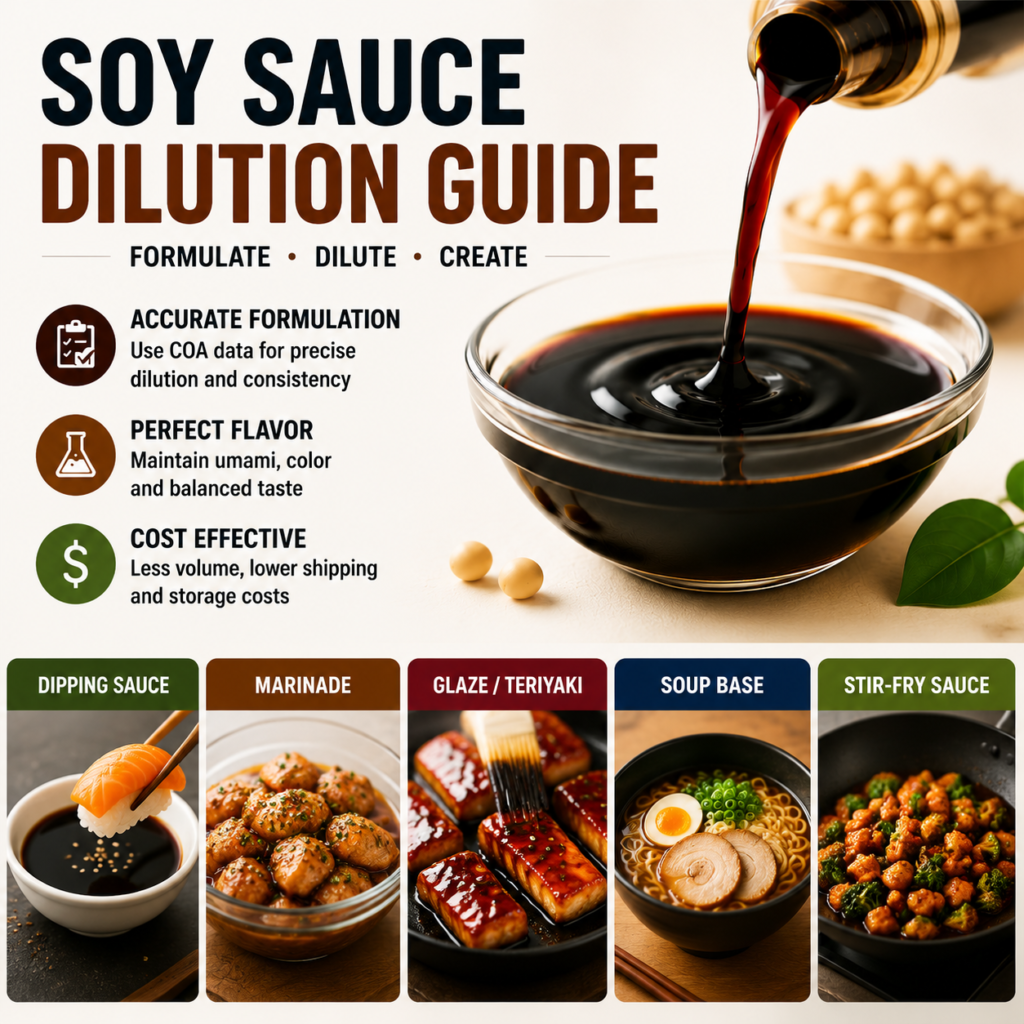
Making thick soy sauce into various end products is a useful skill in food making. It is instrumental in improving production speed, maintaining consistency, and controlling costs throughout your product lines. However, reaching the desired taste of the product, color, and function is beyond the mixture of water only. It requires an intelligent approach that is based on sound science and practical experience.
Making use of concentrated soy sauce instead of a liquid soy sauce offers food manufacturers real and visible benefits. It is a wise decision that pertains not only to cost efficiency but also to product quality.
Making an excellent recipe professionally is not just a matter of hypothesis. Instead, you need to start with a thorough analysis of the technical specifications for your concentrate considering these facts. Reading these figures is the first step to your knowledge about dilution ratios.Initially, you need to have a clear idea of Total Nitrogen (TN). TN is the primary indicator of umami and the overall flavor strength. It is a direct reflection of the amounts of protein and amino acids. The concentrate having a higher TN rating will thus, in turn, reshape the mouthfeel to that of the stronger, savory character. This implies that not infrequently, you are able to achieve the desired flavor with the addition of less product. Thus, it is the more cost-effective solution.Next is salt content or saltiness. Salt is not just a flavor enhancer. It also acts as a natural preservative and is very important in the fermentation process. In your final product, salt is the level that the saltiness affects the taste, microbial safety, and how the other flavors are perceived.Finally, there are the color and Brix scales. Brix is a scale that measures the sugar content. Brix adds to sweetness, the mouthfeel, and caramel notes. The color and Brix are equally important for the aesthetic appeal and final flavor balance of the product. A glaze may benefit from the dark, rich color while the light broth would consider it unwanted.
We hope to help you to kick-start the process with the Recipe Chart we prepared. You might consider this as a professional cheat sheet. It contains proven starting points for the production of common products from a thick soy sauce base. Take note that these are just starting points. You will need to make the necessary adjustments based on the specific concentrate you are using and the target flavor profile.
A clear step-by-step process ensures your concentrated soy sauce works well in any final product.
Step 1: Fix Your Target Profile
First, have in mind your target before the mixture. What is the final salt percentage you must get? For instance, the sauce meant for soaking should have 8% salt while the marinade should have 5% salt. What will be the viscosity and taste of it in general? Write down these targets.Step 2: Calculate the Dilution
Here, you usually take the data from the COA of your concentrate. The calculations are easy.Example: You want to produce a dipping sauce that ends up with a 5% final salt concentration. The COA of your concentrate states that it contains 20% salt. You need to dilute it by a factor of 4 (20 / 5 = 4) to get from 20% to 5%. Therefore, your overall recipe will consist of 1 part concentrate and 3 parts non-salt liquids. The final volume will be 4 parts.These calculations give you a clear starting point for your dilution ratio.Step 3: Create a Test Sample
It is not advisable to jump to a large production run directly. Instead, it is better to go stepwise. Accurately measure the ingredients to create a 100g or 500g sample on a lab bench. It is a low-cost and quick way to troubleshoot.Step 4: Test, Refine, and Repeat
The next step is to assess your sample. Try it out. With the right facilities, measure its pH, thickness, and salt contents. How does it compare to your goal that you made at Step 1? If it is not, you can make changes or add different co-ingredients. We never fabricate products without first making the test sample perfect. The key to successful product development is this repeat process.
There are times when, despite having a great plan, you may encounter some problems. These are the most common issues that food developers face with making recipes using thick soy sauce and some ways to solve them.
The flavor is flat or tastes “watered down.”
Your dilution ratio may be too high. Try a lower ratio (e.g., move from 1:5 to 1:4). Also, consider diluting with a flavorful liquid like a vegetable stock or dashi instead of just water. Most importantly, ensure that the starting concentrate has a high TN value for the umami foundation to be strong.The product is unstable and separates over time.
This is often a thickness or mixing issue. You may need to add a stabilizer or thickener, such as xanthan gum or modified cornstarch. Ensure your mixing process includes a high-shear blending step to create a stable mix, especially if oils are present.The final saltiness is wrong.
Double-check your math. Remember to account for the salt from all ingredients in your recipe, not just the soy sauce concentrate. For reference, target salt levels for products like marinades are typically 4-6%, while some dipping sauces can be higher. This is a critical data point for any maker’s dilution ratio guide.