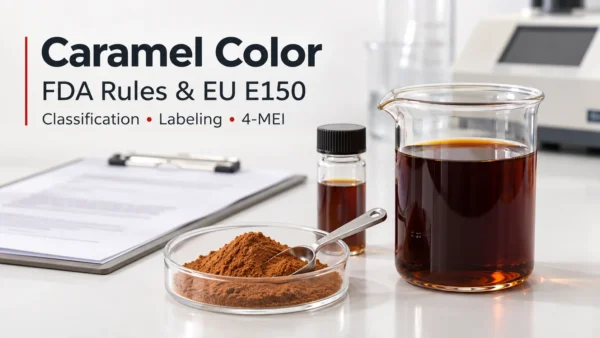
Labeling E150a, or Plain Caramel, should be very easy. But for many food as well as drink companies, it creates a huge issue. What is more, when you penetrate new countries, something which applies in one place can get your product to be rejected in the other. These frequent labeling misunderstandings of E150a in global markets are the cause of expensive problems, delays and customer disaffection. In fact, this brief article will clear up all these issues that you will face. It presents you a simple plan for success.
The Main Problem: Why Does E150a Labeling Change So Much?
The main topic raised here is the global disparity of food norms and rules. The consensus on the cereal E150a label changes depending on the nation involved. This is due to some typical reasons.
- Rules Varied: Officials in both the EU and the US namely the European Food Safety Authority (EFSA) and the Food and Drug Administration (FDA) operate under different rules and entitlement for food additives.
- Customer Demands & Clean Label Trends: In the year 2026, people will desire only such components which are easily comprehensible. This encourages brands to go use atracttive phrases. However, these words may not be allowed.
- Category Assortment of Ingredients: E150a belongs to a category of caramel color with four different colors. It is easy to get and so manufacturing it is easy. With that comes a particular type of labeling guideline.
The item distinctions are periodic science research work references. You can find examples in EFSA’s safety reviews of caramel colours. The four sections are Class I (E150a), Class II (E150b), Class III (E150c), and Class IV (E150d). E150a is a type of “plain caramel”. The compound is produced when glucose is heated under certain lethal conditions. Other methods use these different compounds. This one difference is the fundamental reason why there are so many common labeling misunderstandings about E150a in global markets.
Mistake #1: “E150a,” “Plain Caramel,” and “Caramel Color” Are All the Same
This is the most frequent confusion. These expressions are identical with Class I caramel color. However, these cannot just be used interchangeably as food labels. The correct language is determined by the regulatory standards in the country where your product is sold.
The error of using the incorrect name is quite negligible. Nonetheless, it might lead to problems with regulators who might be forced to stop your progress. Check the table below for the common mistakes in key markets.
| Region | Required/Accepted Name | Common Mistake |
|---|
| European Union | E150a (or Caramel Colour E150a) | The Caramel Color without the E-number belongs to the category of rules breakage. |
| United States | Caramel Color | The use of “E150a” is very unusual for US customers and it isn’t standard. |
| Canada | Caramel Colour / Colour | Using either is acceptable if one is consistent. |
| Australia/NZ | Food Additive 150a / Caramel I | Just “colour” may not be enough. |
| Japan | 銈儵銉°儷鑹茬礌 (Karameru Shikiso) | In case of misinterpreted translation or using English, there can be rejection. |
Undoubtedly, the “right” name can be different for other places. Before finalizing your package design, it is always best to look for the specific regulations of your target market.
Mistake #2: E150a Can Always Be Called “Natural Color”
It might be hard not to want to label E150a as “natural.” It is produced through the heating of sugars such as sugar or corn syrup. This process is quite similar to the way one prepares caramel candy at home. Therefore, the production process of E150a as a plain caramel color has a strong “clean label” appeal.
Nevertheless, the term “natural” is a legally sensitive word on food labels. In many large markets including the USA, any substance that has undergone a chemical change cannot be legally referred to as “natural” on the ingredient list. This holds even when the change is simply due to heating. The laws are often very stringent and vary from place to place.
The situation brings about a major lesson for all manufacturers: The term “Clean label” does not equal “natural.”
The attempt at using the “natural” label may lead to trouble with the law. There are those who would accuse you of deceiving customers. A much more effective and clearer way is to use the right and permitted vocabulary. They can see it as “Caramel Color (for color)” or just simply “Caramel Color” in the ingredient panel. Such inclusion of the ingredient’s simple nature is its best spokesperson. There are no possible litigations in this case.
A Simple Guide to Avoiding Common E150a Labeling Errors by Region
We are your trusted partner because in our decades of experience, we have witnessed best practices of food producers striving to go global. Among the recurring issues, we find that the E150a is the most common mislabeling. We have the checklist for the most vital ones you need to watch out for. This leads to the prevention of common labeling misunderstandings about E150a in global markets.
In the EU: Ignoring Quantity Rules (QUID)
In the case of European Union countries, a mandatory inclusion of percentages in the ingredient list might be required. This is true when you showcase an ingredient on the front of your packaging. E.g., your label could highlight “rich brown color.” If that color is contributed by E150, you will also have to state it as “Caramel Colour E150a (0.5%).” These rules are a way for manufacturers to avoid misleading customers about the amount of any ingredient they include in their products.
In North America: Forgetting Allergen Information
The primary thing to consider is that E150a is not a common food allergen. Despite this, the sugar source employed in its production may cause allergies. If your caramel color is produced from wheat, you are obliged to indicate it. The need for this information is dictated by the Food Allergen Labeling and Consumer Protection Act (FALCPA) in the US. It necessitates that the label states “Caramel Color (contains wheat).” However, being aware of the origin of your ingredients is a priority.
For Everyone: Using a Single Label Can Cover Anything
The worst mistake a brand can be making is to think that a domestic label will also be good for external trade. Exactly at this spot, that is where and when the most deviating problems emerge. Each market has a specialized vocabulary for referring to regulations. You are required to have a perfect command of their language. The same rule is applicable in various other sectors, e.g. shipping, since, experts insist, incorrect marking and labeling lead to shipment delays and breaches of rules across every industry.
Recognizing these geographical variations is why it is best to have a company that has knowledge of global rules as a partner. For example, our Custom Caramel Color – Qianhe solutions are specifically developed with the diverse regulatory scenarios in mind. Consequently, you are ensured of obtaining the correct shade with all the necessary documentation from the beginning.
The Maximum: How High-Quality E150a Simplifies Labeling
E150a is not uniform. A trustworthy manufacturer who provides a premium and regular product is much less likely to incorporate trace elements or any reaction by-products. These can be difficult to maintain in your labeling and regulatory declarations. Opting for an excellent ingredient is the first step towards an immaculate and legal label.
Similar to our High-Salt Dilute Authenticity Brew鈩?/strong> which is the benchmark for process control and purity in fermentation, we adhere to equally high standards for all our food ingredients. The use of Class I caramel color from a supplier that is committed to this level of quality not only guarantees that you get what you see inside the bottle but also that the specifications you provide are adhered to correctly. This removes any doubts. In relation to that, this culture of quality is a great help amid the difficulties of global food markets in 2026.
Frequently Asked Questions (FAQ) on E150a Labeling
Here is a list of some of the questions we usually get regarding E150a labeling together with their respective answers.
1. What are the consequences of labeling E150a with the wrong name?
The consequences of this mistake can go from just a warning to relabeling, border rejection of your shipment, fines, or a required product recall. The degree of the damage you will get ultimately depended on the country and the specific act of breaking the law.
2. Is E150a regarded as a “synthetic” colorant?
E150a is not typically mentioned as synthetic. It is formed by controlled heating of sugars. The process is better known as caramelization. However, in many legal frameworks, it is, of course, not considered as “natural” as well. It occupies an unusual position as a “clean label” color additive.
3. Should I include E150a in the list even though it is only used in a very small amount?
Most of the time, yes. Generally, in all countries, such as the US and the EU, all intentionally added ingredients must be stated. This applies even to the smallest amounts. Labeling the other way is a very common misconception.
4. My E150a is derived from corn. Must I write “corn” on the label?
In the United States, corn is not one of the nine major allergens that need a specific source listing. However, if your caramel color was derived from wheat, you would have to specify that (for example, “Caramel Color (from wheat)”). You need to be aware of the source material and the allergen laws in your target market.
5. Can I just put “Color Added” on the ingredients list?
Normally, no. This phrase is overly vague according to the rules of food labeling nowadays. Both buyers and authorities in 2026 expect to see transparency. You must mention the specific color additive’s legally accepted name. Such as “Caramel Color” in the US or “E150a” in the EU.