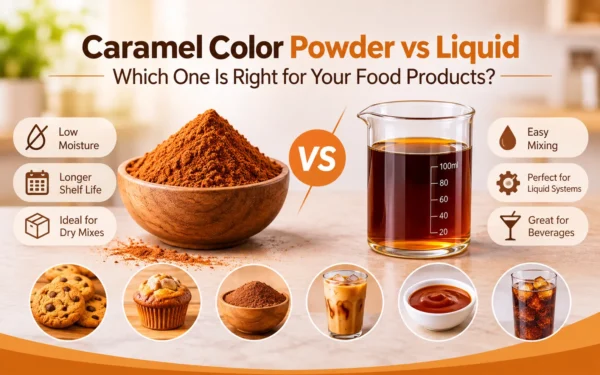
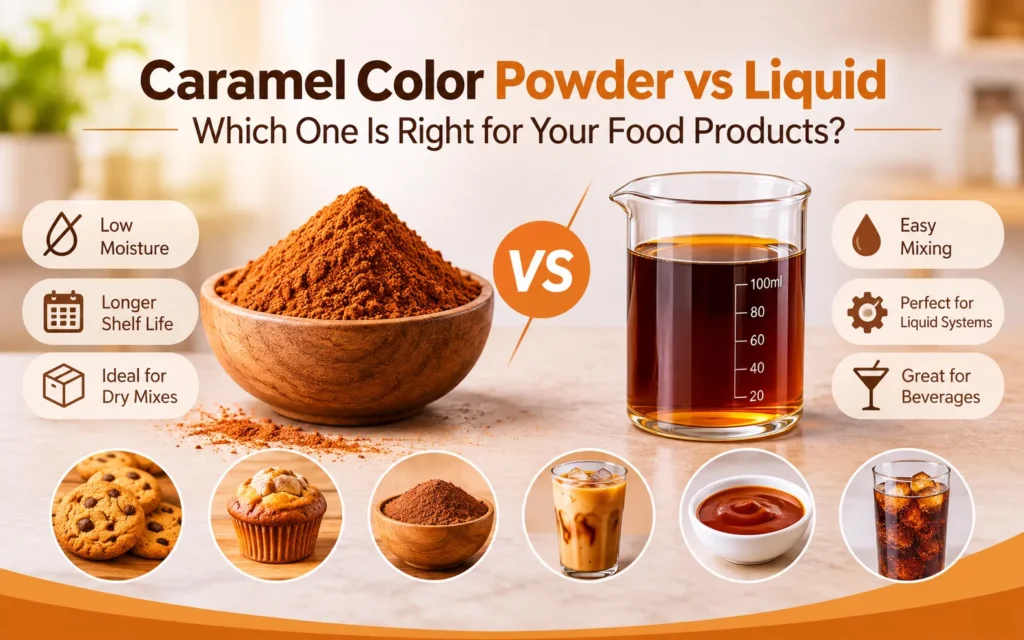
Liquid vs. Caramel color powder is one of the most crucial decisions any food professional has to make. This decision affects the manufacturing process, the product’s quality & the financier’s factor to some extent. This query is a major subject that we help our customers with every single day. The solution does not consist of any one of these forms being better than the other. It is dependent on what is best for your specific needs. The perfect form of caramel color will be determined by three factors: the humidity of your product, the way you use it, and the storage and handling methods you apply. Caramel color is a very useful tool which can be used for designing and decorating dried products, as well as many other foods. Therefore, the first thing is to choose the right one.
Overview: Key Differences between Powder and Liquid Caramel Color
As a quick overview, here is a list of the main differences. The table below shows you the pros and cons of the two formats at a glance.
| Attribute | Caramel Color Powder | Liquid Caramel Color |
|---|
| Form | Free-flowing, fine powder | Viscous (thick) liquid |
| Moisture Content | Very low (typically under 5%) | High (could vary from 30% up to 50% or even more) |
| Shelf Life | Longer (often 2 years or more) | Shorter (usually 6-18 months) |
| Handling & Storage | Needs dust control; takes up less storage space | Easier to pump; may create mess; requires more space |
| Dosage/Dispensing | Best for manual and precise weighing | Best for automated and high-volume dosing |
| Application Suitability | Dry mixes, baked goods, confections | Beverages, sauces, syrups, marinades |
| Cost (Transport & Storage) | Cheaper to ship and store (less weight/volume) | More expensive to ship and store (water in shipping) |
| Dissolution/Miscibility | Needs a dissolution step (e.g., slurry) | Mixes instantly into liquid systems |
The Clear Choice: When to Use Caramel Color Powder
The decision to opt for caramel color powder instead of liquid caramel color boils down to one word: moisture. If you want to maintain the dryness of your product, powder is the evident choice.
Perfect Choice for Dry Mixes and Seasoning Blends
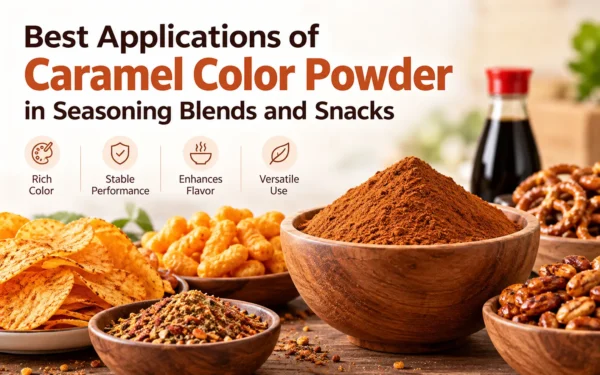
The only intelligent choice for any dry powder-wet blending is powdered caramel color. Consider cake mixes, instant soup powders, spice rubs, or powdered drink mixes. Here, the use of a liquid would cause moisture addition. This leads to clumps, bad flow, and possible spoilage.
From what we observed, mixing a little liquid completely and evenly into a whole batch of dry ingredients is a weighty task. You risk creating color areas or hot spots and then a product that is not even. On the other hand, if you put a powdered colorant in a ribbon or V-blender, then there is no problem. You will have a complete even distribution of color. That’s why you should always opt for caramel color powder.
Best for Baked Products and Sweets
In baking, the water content is like number play. The adding of one gram of water could have a direct effect on how the dough or batter handles and subsequently, the end product’s texture. The use of powdered caramel color means that you will add different colors without altering the formula’s hydration.
This is key for items such as cookies, crackers, and even some types of bread that are meant to be crispy or come with a specific crumb structure. The color you get is the rich brown you like without the product turning soft or chewy.
Strengths in Transport, Storage, and Shelf Life
Powder has a lot of advantages for the logistics and transportation industry. Moving powder as cargo is much lighter than liquid, which is more due to the water it carries. This could significantly reduce freight costs. It is also a better solution to warehouse it.
Furthermore, the fact that it is a low moisture product makes it stay fresh for a longer period. Also, it makes less likely for the product to breed microbes. Like Caramel Color Powder | Rich Food Brown Caramel Color is a perfect choice, it offers excellent dispersibility and a stable, rich brown color profile perfect for these uses.
Caramelization Concentration of Color is Most Important
Caramel color powders are packed with colors. You can easily get a brilliant, fuller color with small amounts of powder. This was particularly helpful when you are trying to hold good the weight and volume of your formula.
The Most Recommended Choice: Use Liquid Caramel Color When It is Necessary
It is true that the use of powders has advantages; however, there are many situations when liquid caramel color is the better and more productive choice. In production, if your process is already liquid-based, it is better to use the same kind of ingredient.
A Must-Have for Alcoholic Beverages and Syrups
A liquid color is the best option for drinks like soft drinks, iced teas, beers, and coffee syrups. It is in the right state for it to be mixed in immediately and promptly.
Using a liquid not only avoids the extra step of dissolving a powder but also helps in saving time in production. Moreover, it eliminates the risk of undissolved specks in the final product. This is why liquid caramel is so common in beverages and sauces.
Ideal for Automated Dosing Systems
Automation in food production lines is a compulsion for large-scale food companies if they want to remain competitive and want to ensure consistency. These systems frequently employ pumps and meters to add liquid ingredients straight into the mixing tank.
The integration of liquid caramel color is seamless in these automated dosing systems. Consequently, it drastically improves the productivity of labor besides enhancing the batch-to-batch consistency in high-volume manufacturing. The accurate functioning of these systems leads to every bottle of soda or jar of sauce being produced with exactly the same color.
Best Choice for Sauces, Marinades, and Gravies
In sauces, marinades, and gravies, liquid caramel color is easy to add. It integrates perfectly into the liquid base of the recipe.
In some cases, the thickness of the liquid caramel can be a benefit. It can contribute slightly to the overall mouthfeel and coating properties of a sauce or glaze.
More than the Initial Decision: Other Important Factors to Weigh
Choosing to use caramel color powder instead of liquid caramel color goes beyond just dry vs. wet. Dry and wet are not the only determinants; here are some expert-level factors to consider to prevent costly mistakes.
Effect on Water Activity (aW) Level and Shelf Life
Water activity, or aW, is the percentage of water that is available free for the growth of microorganisms in any available food. It is a major element of shelf-life.
Caramel powder has almost no impact on a product’s water activity. This makes it essential for intermediate-moisture foods like nutrition bars, fruit fillings, and some pet treats. Using a liquid form will increase the aW and this alone might make the food product unsafe.
In contrast, liquid caramel adds water to a formula. This extra water needs to be accounted for in the total recipe. This ensures the final product’s aW is low enough to be shelf-stable.
Accuracy of Dosage: Pendant Lab vs. Production Scale
The selection of materials may also depend on the scale of your work. For example, in the development of a product in the lab, it is simple and accurate to weigh a few milligrams of a highly potent powder with a balance. But even in a big factory, handling fine powder can create dust. This issue has consequences for a worker’s safety and cross-contamination.
In contrast, dosing a thick liquid in a small lab beaker may be difficult, due to having to use a precise, small amount. But in a full-scale plant, automated pumps can dose that same liquid with perfect repeatability, batch after batch.
Classification and Format of Caramel
Caramel colors are classified as four classes (Class I, II, III, and IV). These classes are dependent on the reactants involved in their production. They have a significant effect on the properties, such as tonal color and stability in acid.
Selection of a class frequently outweighs the selection of a format. Truly, certain classes tend to be more prevalent in a specific format. For instance, Class IV is the indicative class for colas because of its dark hue and higher acid stability. It is generally available in the form of a liquid. It is excellent to understand that you can find a variety of options in these four classes that would suit your desired grade and format.
From Theory to Practice: A Brief Guide to Formulation
Knowing when to choose caramel color powder or liquid is the first step. The next is knowing how to appropriately apply it.
Best Practices for Using Caramel Color Powder
- Pre-blending: To avoid clumps, always mix the powder with another dry ingredient from your recipe, such as sugar or flour, before adding it to your main batch. This will separate the particles and help them dissolve evenly.
- Dissolving: If you are adding powder to a liquid system, first create a slurry. Whisk the powder into a small amount of liquid from your recipe until it forms a smooth paste. Then, add this paste to the rest of your liquid.
Best Practices for Using Liquid Caramel Color
- Viscosity: Certain liquid caramels can have a high viscosity. If you are struggling to pour or pump it, then heating it up a bit can decrease its viscosity and facilitate its manipulation.
- Order of Addition: The liquid caramel should be included in the main liquid part of your recipe at the beginning of the process, i.e. when mixing. This will allow it to be distributed completely and thus obtain a uniform color.
A Note on Quality and Consistency
Regardless of the format you select, the outcome will depend on the quality of your color. Using a high-quality, consistent caramel color is the secret of producing a great product every time.
Just like the ancient “High-Salt Dilute Authenticity Brew™” method, which requires meticulous raw material and processing controls to achieve its unique quality, the best caramel color is made from the same principles of precision and consistency. This will ensure that you get the same results every time and therefore, keep your brand’s image intact.
Frequently Asked Questions (FAQ)
Can I directly replace liquid caramel color with powder in recipes?
No, it is not advisable to do so. You have to consider the difference in concentration and liquid’s water content. Since powders are concentrated, you require less. On the other hand, the liquids add moisture, which may cause an imbalance in the formulation and affect its texture and shelf life.
Will caramel color powder or liquid affect the taste of my product?
Generally, caramel colors are utilized at a very low level and are formulated to have minimum impact on flavor. However, some types, such as Class III, can contribute a little bitter or burnt sugar hint. This can be preferable for goods like dark beer or pumpernickel bread, where it serves to provide complexity.
Is there a price difference between caramel color powder and liquid?
The powder generally sells at a higher price per kilogram, but it is also more concentrated leading to less consumption. The total expenditure can be lower for the powder since it has less shipping weight and a longer life on the shelf. The most effective way to compare is on a “cost per unit of color” basis for your specific application.
How do I properly dissolve caramel color powder to avoid clumps?
The best method is to create a slurry. Vigorously whisk the powder into a small amount of cool or room-temperature liquid (like water or milk from your recipe) until a smooth paste is formed. Then, you can incorporate this slurry into the rest of your liquid ingredients without fear of clumping.
Which format is better for “clean label” products?
Both formats are labeled simply as “Caramel Color” on an ingredient statement. The “clean label” perception is more about the class than the format. Class I (Plain Caramel) is often seen as the “cleanest” option because it is made without ammonia or sulfite compounds. Both powder and liquid versions of Class I are available, so the decision of when to choose caramel color powder instead of liquid caramel color still depends on your application.