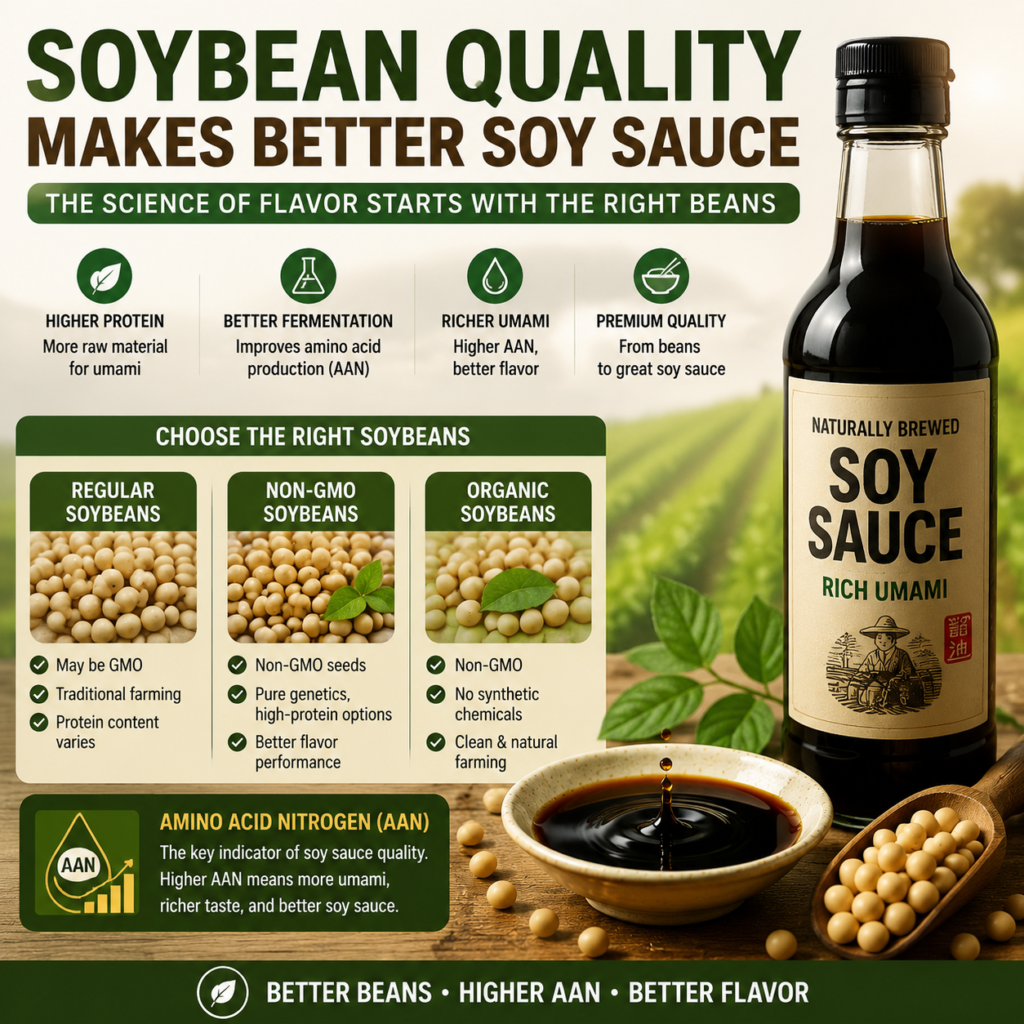
For every chef or any food worker, the first step is to know the ingredient well enough. When it comes to soy sauce, the most prominent one is always the soybean. Indeed, the choice of bean is nothing to be trifled with. It significantly alters the quality of the end product. This is the reason why your study of the variants of soybeans is the most important thing for any cook who wishes to improve the taste of a dish. Three types of beans are found on the market, namely: regular, non-GMO, and organic.Each of the types makes the fermentation process work differently. It also leads to the different amounts of the AAN in the product. It in turn alters the taste of the soy sauce.
To learn how soybean selection determines the final product, we need to explain soybean classification terms. These labels carry critical meaning for soy sauce manufacturers, far beyond mere marketing.
Regular Soybeans
Regular soybeans are grown using standard conventional agricultural practices. This category also includes genetically modified varieties. Farmers apply synthetic fertilizers and pesticides, with the primary goals of boosting crop yields and improving pest resistance. However, soybeans from conventional farming often have inconsistent traits such as varying protein levels, which greatly alters the flavor of the finished fermented product.Non-GMO Soybeans
Non-GMO soybeans are grown from naturally reproduced seeds without artificial genetic modification. Production centers around the crop’s original genetic makeup, giving brewers a wider range of options. Producers can pick heirloom or improved strains valued for desirable traits like high protein content. Mastery of brewing with non-GMO soybeans is essential for crafting premium soy sauce, as soybean protein forms the foundation of rich umami flavor.
The central measure that determines the quality of soy sauce, among others, is the amount of Amino Acid Nitrogen (AAN), which is the supreme measurement for that. This is the scientific link between a soybean and excellent sauce.Amino Acid Nitrogen (AAN) basically indicates free amino acids in soy sauce. During fermentation, complex proteins in soybeans are broken down into simpler parts through this process. Along with these are the amino acids such as glutamate. AAN counts the amount of these compounds that are rich in flavor. It has a direct relationship with the umami flavor. Umami is the savory “fifth taste” contributing to the profound, satisfying character of soy sauce. Thus, higher AAN correlates with more umami.
From the perspective of a master sauce fermenter, soybeans are far more than just raw ingredients—they are a core component that defines the months-long fermentation cycle. The initial choice of soybean variety sets the trajectory of the entire multi-month fermentation process. Learning about the distinctions between soybean varieties allows us to grasp how each type behaves uniquely throughout soy sauce fermentation.
High-Protein Soybeans in Koji Making
The core principle is simple: higher protein content delivers deeper, richer flavor. Soybean protein acts as the essential foundation for koji fermentation. If low-protein soybeans are used as the base, the maximum amount of AAN we are able to generate will be capped, no matter how skilled the fermenter is. High-protein non-GMO soybeans offer an optimal starting material, yielding maximum AAN levels and a markedly enhanced flavor profile.
The first step to achieving the next level of excellence is the choice of high-protein, non-GMO soybean types. This strategy delivers the consistency and high-protein raw material essential to achieving the desired AAN levels and, consequently, the fantastic taste.