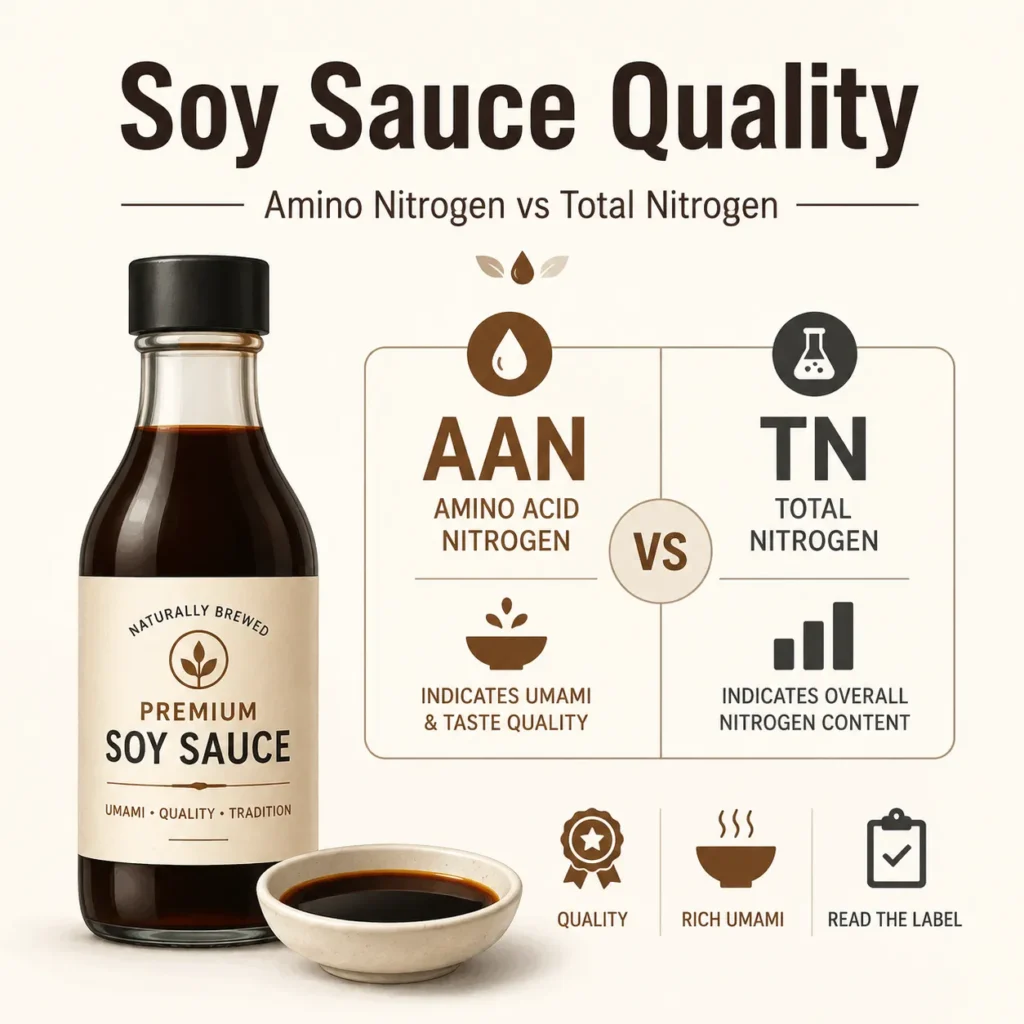
You might have been there and found yourself confused by the wide variety of soy sauce available on the shelf. As you scan the products, do you find yourself questioning what criteria should determine which bottle considered superior? The answer mostly is based on two crucial terms: Total Nitrogen and Amino Acid Nitrogen. These abbreviations may seem complicated to some, but they offer great insight into soy sauce.
When reading the soy sauce’s labels, you may happen to see terms such as Total Nitrogen (TN) or Amino Acid Nitrogen (AAN). These are not solely the interest of the food scientists. They are, in fact, your first-hand information bearing hints on what is contained in the bottle.With this knowledge set, you will be able to see beyond the marketing plays. You can acquire the skills to differentiate really good and delicious soy sauce. Taste, of course, the key factor, is the AAN. The more it is, the stronger umami is.Terms like soy sauce quality will be treated in a more straightforward manner. Key differences will attract our attention. We will demonstrate the connection with flavor, smell, and overall quality in the bottle.
Comparison Table: Total Nitrogen vs. Amino Acid Nitrogen
The incredible taste of soy sauce is not a result of luck, instead, it is a product of a thorough and lengthy process of several months. By acquiring this knowledge, you will understand the notable effects of AAN.Firstly, it commences with the basic materials which are high-protein soybeans and wheat. In the initial phase, most of the nitrogen is contained in long chains of proteins that are too large and too complex for the organism to easily break. Consequently, these proteins have a bland taste of their own.Following is the “koji magic.” Thereafter, the fungus Aspergillus oryzae is the special mold which forms on the steamed soybeans and roasted wheat. This koji mold is the source of protease enzymes. These enzymes function as mini scissors which fragment them into smaller parts, the initial step of the whole process.From there, the mixture goes to the moromi stage. The koji blends with saltwater brine which generates a mash. This mash ferments in enormous boilers for periods ranging from months to years. At this stage, the protease enzymes are laboring. They perform an operation called hydrolysis. This means the total breakdown of proteins during fermentation.During this decomposition, numerous amino acids are released. One of the key ones is glutamic acid. This is the main element that triggers the umami taste. A long and vigorous fermentation is the key factor to a high AAN. It results in the production of a soy sauce that is deep, complex, and has a rich savory flavor.
Now you can use this knowledge in the grocery store. High-quality soy sauce makers are proud of their fermentation process. They often show the AAN or TN content right on the label. This marks quality.Look for a line that says “Amino Acid Nitrogen ≥ X g/100ml” or “Total Nitrogen (TN): X%.” This is your guide.