Do you feel puzzled when you read the terms “Special Grade” or “First Grade” on a soy sauce bottle? You are not the only one. A large number of people find themselves in the aisle of the store staring at the multitude of brands before choosing based on the trademark or cost. However, what you should understand is that there is a reason to find the authentic true premium. The starting point is the measurement by which amino acid nitrogen is the only one that is available. As the name implies, AAN is the major way to determine the strength and quality of the flavor in a soy sauce.
The Source of Umami and Richness
Amino Acid Nitrogen measures the free amino acids in soy sauce. The most famous is glutamic acid. This creates the natural “umami” savory taste.You should regard it as an essence of pure taste. So the soy sauce tastes stronger, more bitter, and more complicated the higher the AAN number.These amino acids are not added, but they are generated during the brewing process, during which specific enzymes hydrolyze proteins. These enzymes are obtained from the koji mold. They act on the soybeans and wheat.Not Just for the Flavor: It Is also a Mark of Real Brewing
The high AAN level reflects the long age, traditional brewing. It is a testimony of the maker’s patience and no-shortcut-taking ethics. The core essence of soy sauce quality and grading is here.This is quite unlike non-brewed or “chemical” soy sauces. Those products are made by acid breaking down the soy protein quickly. They lack the rich and complex flavor of sauce that is properly brewed. The slow and natural amino acid creation process does not take place.
Now, let us link the scientific facts to the product labels. Soy sauce categorization is not just a marketing gimmick. It is grounded in authentic and measurable conditions.
The Numerical Approach: A Global Benchmark
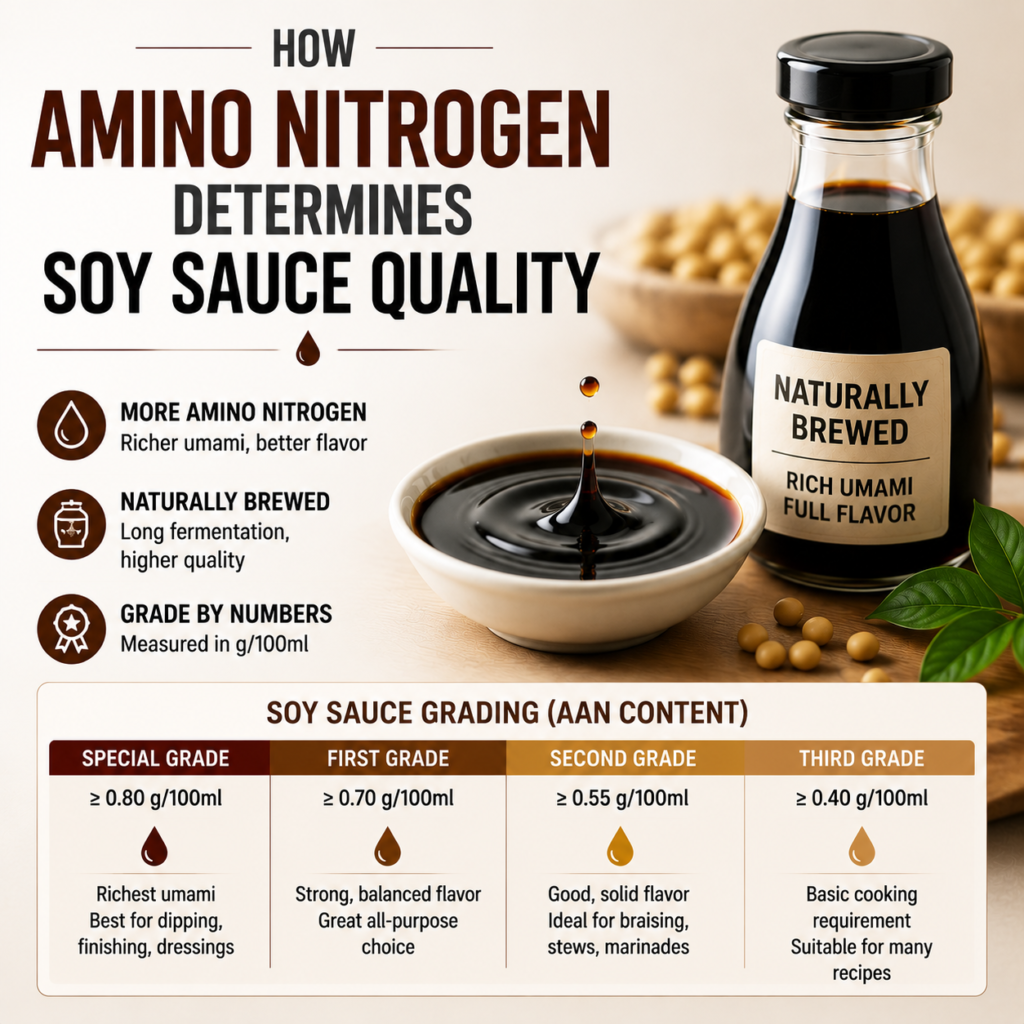
Globally, food regulations apply AAN content as the classification standard for brewed soy sauce. Therefore, we have a reliable method for the understanding and comparison of products.The universal metric used on the packages is grams per 100 milliliters (g/100ml). The larger the number the higher the grade.The Comparison of Soy Sauce Grading Systems
The evaluation of rules varies across the world. But the principle is the same. The Chinese National Standard (GB 18186) is an excellent example. A lot of references are made to it. The document is straightforward, to the point, and recognizes the influence of amino nitrogen in the quality and grading of soy sauce.
AAN doesn’t just magically appear. It is formed through the brewer’s skills, time, and technique. This is the point where true artistry differentiates a top soy sauce from all the rest.
Time is the Secret Component
The greatest AAN levels result from prolonged natural fermentation. In the process, koji, yeasts, and bacteria are given enough time that lasts for 180 days or more. Only then can they completely and slowly break down the soybean proteins.This slow process, in turn, increases AAN content to the maximum. Apart from this, it helps add new complex fragrances and secondary flavors. A quick, industrial version of the process just can’t replicate it.The Impact of Brewing Method
The most important factor is the brewing method in itself. The traditional craft known as the High-Salt Dilution Brewing™ process is precisely engineered to achieve optimal brewing results.The method involves incorporating a sizable amount of sodium right away into the mash. This acts as a safeguard to prevent the mixture from being destroyed. It facilitates the work of beneficial microbes who work slowly and steadily. The outcome is a full, naturally fermented product high in AAN that is free from the need for artificial additives. This is indeed a result of the commitment to the process, which is the primary factor for the effect of amino nitrogen in the soy sauce quality.The Need for Good Raw Materials
Here’s the deal: the process is only effective with good and quality ingredients. You cannot produce a high-AAN soy sauce from bad raw materials.The process begins with the careful selection of the best possible non-GMO high-protein soybeans. The more protein the beans have, the more raw materials the process has to collaborate. Ultimately, this translates to a higher number of delicious amino acids in the final soy sauce.
Now that you are aware of the theory let’s focus on practical tips. Here are three simple steps that you can utilize during your next shopping trip for selecting quality soy sauce.
Step 2: The Shake Test
This is an old but gold tip from manufacturers’ representatives. Lightly shake the bottle.A top-grade, AAN soy sauce will produce a thick, reddish-brown foamy head when shaken. The bubbles will be small and tight and they will take some time to disappear. This foam is an indicator of the size and number of amino acids and proteins present. On the other hand, a cheap sauce will produce airy, watery, and ephemeral foam.
Although AAN is a great indicator, the best soy sauce for you might not necessarily have the highest figure. Cooking is an art that is all about balance and relativity.
Pairing the Grade with the Dish
A Special Grade soy sauce (≥0.80g/100ml) has deep and complex flavors that it is the best option for those dishes that specifically use it such as dipping sushi, adding to steamed fish or preparing a strong dressing. In these respects, the soy sauce takes the lead.Nevertheless, the same level of intensity could overshadow the subtle flavors in a soup. For the long-cooking foods such as braises, stews, and marinades, the First or Second Grade soy sauce is often the best choice. Its flavor will mix with other ingredients seamlessly. It is also usually cheaper.AAN is Not the Whole Story
At the same time, AAN serves the purpose of the primary indicator for umami; however, a good soy sauce is all about the orchestra of the sensations. The other parameters that add to the overall odor, the degree of color, the saltiness. the balance of other compounds are also part of the overall taste that should be satisfied. To a master brewer, all these things have to achieve a perfect state of equilibrium. Actually, the complexity of the subject is such that some research even delves into the intricate correlation between quantifiable nitrogen levels and sensory evaluation results. Thus, it appears that the interpretation of the taste is much more than just one number.