Dual-sourcing caramel color is not simply keeping two quotations on file. A backup source is useful only when a named grade from a named manufacturing site has passed document review, application testing and release planning before a disruption occurs.
Quick answer: Qualify the supplier, the exact caramel color grade and its performance in your finished product as three separate decisions. Lock the approved specification and test methods, validate the candidate from bench sample to commercial batch, define which changes require notification or requalification, and keep the secondary source ready through periodic review and controlled use.
The goal is not to prove that two materials look similar in a beaker. The goal is to know, with evidence, that either approved source can repeatedly produce a releasable batch under your formula, process, packaging and destination-market requirements. That is what turns a second supplier from a name in a spreadsheet into a real continuity option.
Why “Two Suppliers” Often Fails in Practice
Many dual-source projects stop too early. Procurement approves the company, R&D tests one sample, and the second grade is marked “equivalent.” Months later, an urgent switch exposes differences in hue, strength, ionic behavior, viscosity, solubility, residue, sensory impact or documentation.
The E number alone is not an equivalence specification. Class I, II, III and IV describe manufacturing-reactant categories; they do not guarantee identical performance between grades or suppliers. Review the functional differences in Qianhe’s Caramel Color Class I–IV guide, then qualify the actual grade in the actual food matrix.
The Qualification Workflow at a Glance
Use gates, not a single yes/no checkbox. Each gate should have an owner, required evidence and a written stop rule. Procurement can coordinate the project, but R&D, QA, regulatory, production and supply planning each approve their own part.
Step 1: Confirm the Second Source Is Actually Independent
A different sales company is not necessarily a different supply chain. Before spending money on trials, map the manufacturer, manufacturing site, key raw-material route, finishing or spray-drying site, packaging source, warehouse, port and main logistics lane. The aim is to find correlated risks, not to demand that every upstream input be unique.
- Manufacturing dependence: Are both offers made at the same factory or toll processor?
- Form dependence: Does a powder grade rely on liquid feedstock from the same production line?
- Geographic dependence: Could one weather event, utility failure, port closure or regional restriction stop both routes?
- Commercial readiness: Is the secondary source willing to support the required MOQ, forecast, sample plan and emergency lead time?
- Information dependence: Is the manufacturer—not only the trader—identified on the approved record?
Independence is risk-specific. Two sources may share one risk yet still reduce another. Record the remaining common failure points and decide whether inventory, a third logistics route or another control is needed.
Step 2: Freeze the Technical and Regulatory Target
Start from the result your finished product must achieve, then translate it into an ingredient requirement. If the team begins with two supplier data sheets, it may unconsciously accept whichever values happen to be listed. A user requirement specification keeps the comparison anchored to your product.
Define the finished-product acceptance window
Set the target shade and tolerance, sensory limits, clarity or opacity requirement, sediment or ring criteria, heat and hold conditions, shelf-life checkpoints and packaging conditions. Record the measurement timing and sample preparation. A visual standard may support evaluation, but it should be paired with controlled conditions and, where appropriate, instrumental data.
Define the caramel color requirement
Depending on the application, relevant fields may include class, liquid or powder form, color intensity and method, hue or red index, ionic charge, pH, density or moisture, solubility, viscosity, particle behavior, purity limits, microbiological criteria, packaging, shelf life and storage. Use only fields that matter to the product and market; do not build a decorative specification that nobody uses.
If the first technical question is still “which grade family fits our matrix?”, use the caramel color selection guide before opening a supplier comparison. Liquid and powder also need different handling controls; compare the practical differences on the caramel color liquid page and caramel color powder page.
Attach a method to every critical number
“Color intensity: 0.20” is incomplete without the analytical method, dilution basis, wavelength, cell path length, solids basis and units. The same applies to pH, density, moisture and other release values. Before comparing historical COAs, confirm that both suppliers are measuring the same thing in the same way.
Step 3: Qualify Three Layers Separately
Layer A: Supplier and manufacturing siteCan the organization and named site consistently manufacture, test, release, trace and communicate changes for food-grade caramel color?
Layer B: Exact material gradeDoes the named grade meet the agreed identity, specification, compliance, packaging and document requirements?
Layer C: Your applicationDoes that grade, at its approved dosage and process, meet finished-product color, sensory, stability and release criteria?
Keep the approval wording precise: “Supplier B, Site Y, Grade Z, for Formula 123 under approved conditions.” Approval for a beverage does not automatically approve the grade for a high-salt seasoning, and approval of one plant does not automatically cover another manufacturing location.
Step 4: Build a Decision-Ready Document Pack
Request documents based on risk, destination market and customer commitments. The list below is a working starting point, not a universal legal checklist.
- Product identity: specification, technical data sheet, ingredient or processing declaration, grade code and physical form.
- Batch evidence: representative COAs, test methods, release limits and—when needed—trend data across multiple commercial lots.
- Food-safety controls: applicable certification, audit evidence, traceability and recall information, and risk-based supplier verification evidence.
- Regulatory status: market-specific statements and applicable limits for the caramel color class, rather than a broad “global compliant” sentence.
- Customer programs: allergen, GMO, Halal, Kosher, organic or other declarations only where relevant to the finished product.
- Supply details: named manufacturing site, packaging configuration, shelf life, storage, MOQ, standard lead time and emergency contact route.
- Change control: agreed notification categories, notice period, required supporting evidence and approval route.
Compare the supplier pack against your requirement line by line. Mark each field as accepted, conditionally accepted, gap, not applicable or pending verification. “Document received” is not the same as “requirement met.”
Step 5: Use a Trial Ladder That Matches the Risk
Do not jump from a supplier sample to unrestricted production. The trial ladder should be proportionate to the product, process and consequence of failure, with acceptance criteria written before results are seen.
Challenge the real formulation
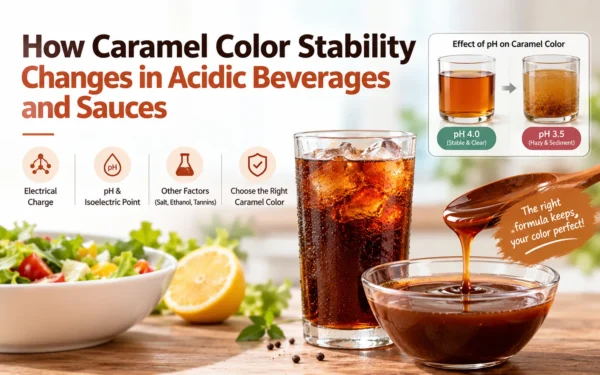
Include relevant pH, salt, alcohol, protein or tannin conditions; heating and holding; addition order; shear; filtration; filling; and storage. For low-pH drinks, start with Qianhe’s beverage application guidance. For soy sauce, oyster sauce and compound seasonings, review the caramel color for seasonings page. Application guidance narrows the search; it does not replace validation in your formula.
Use representative material
Record supplier, site, grade, lot number, manufacture date and sample source. When risk justifies it, compare multiple commercial lots rather than repeatedly testing one specially prepared sample. Retain samples under defined conditions, but remember that an aging physical “golden sample” is not a permanent analytical standard.
Do not force a one-to-one dosage substitution
Strength data can help set a first screening range, but the approved addition must come from the finished-product result. A candidate can meet a color reading and still differ in hue, clarity, sensory profile or storage behavior. Keep a source-specific dosage or approved operating range when that is what the evidence supports.
Step 6: Convert Trial Approval into Plant Controls
A signed trial report does not control purchasing, receiving or production. Before the second source is activated, translate the decision into the systems people actually use.
- Add the exact supplier, site and grade to the approved vendor/material record.
- Use separate item codes or another unambiguous source-control method where needed.
- Issue source-specific specifications, COA review rules and incoming test plans.
- Update the bill of materials, recipe, dosage instruction and line-side identification.
- Define whether sources may be alternated, campaign-controlled or used only after QA authorization.
- Set first-receipt, first-batch and post-switch monitoring requirements.
- Confirm whether label, customer, regulatory or export-market actions are required before use.
Avoid mixing two sources in the same batch unless that practice has been deliberately assessed and approved. Mixing can hide a source-specific issue and makes investigation, traceability and performance attribution harder.
Step 7: Put Change Control in the Quality Agreement
“Please tell us if anything changes” is not a change-control system. Define the events, timing, information package and approval path in writing. The required action should be based on potential impact, not on whether the supplier calls the change “minor.”
For each notified change, record the old state, proposed state, reason, affected lots, implementation date, supporting comparison data and recommended customer action. Your cross-functional team then decides whether to accept by document review, require confirmatory testing, run a new plant trial, notify customers or reject the change.
Notification received → impact assessed → evidence completed → approval recorded → effective lot released
A supplier’s notification does not replace your own hazard, regulatory, label, customer and application review. Requirements also differ by country and customer, so the change matrix must be adapted to the markets you serve.
Step 8: Prepare the Switch Before You Need It
The first emergency order is the wrong time to decide how the backup will be released. Create a short activation plan that names the decision owner, trigger, available stock, purchase route, transport lead time, receiving tests, production instructions and customer-communication checks.
- Confirm that supplier, site, grade and documents still match the approval record.
- Check the latest COA, manufacture date, remaining shelf life and transport condition.
- Apply the agreed enhanced incoming inspection for the first receipt or after a long inactivity period.
- Run the approved source-specific recipe and identify the batch clearly.
- Hold finished product until the defined first-switch release results are accepted.
- Review performance after the first agreed number of batches and close temporary controls only with evidence.
If a secondary source has not supplied for an extended period, treat activation as a controlled re-entry. Check whether the grade, site, specification, method, packaging, certificates or your own formula and process have changed since the last approval.
Step 9: Keep the Backup Source Qualified
A dormant approval decays. Build the secondary source into the supplier-monitoring program with a frequency based on risk and business importance.
- Trend COA and verification results for critical attributes rather than filing them lot by lot without review.
- Track complaints, deviations, on-time delivery, shortages and response quality by supplier and site.
- Renew expiring certificates and market/customer declarations.
- Review open changes, audit findings and corrective actions.
- Periodically confirm availability, MOQ, lead time, packaging and emergency contact details.
- Consider a planned order or switching drill when prolonged inactivity would make emergency use uncertain.
- Define requalification triggers: material change, site change, prolonged inactivity, repeated drift, formula/process change or new market requirement.
Volume allocation is a business decision, not a universal quality rule. Some buyers maintain both sources through routine split volumes; others keep one approved contingency source and schedule periodic verification. Choose the model that preserves readiness without creating avoidable complexity or obsolete stock.
Compare Commercial Value Only After Technical Acceptance
Once both candidates pass the required gates, compare delivered cost, approved dosage, handling, loss, QC, MOQ, inventory exposure, lead time and one-time qualification work on the same basis. The cheapest quotation is not automatically the lowest cost per released batch. Use the caramel color cost-in-use workflow to structure that calculation.
Resilience also has value, but do not hide it inside a vague premium. State the service level or disruption scenario the second source is intended to cover, the remaining common risks and the annual cost of keeping the source ready. Decision-makers can then see what they are paying for.
What to Send When Requesting a Qualification Sample
A useful sample request tells the supplier enough to recommend a relevant grade and document pack. Share the application, target shade, current caramel color class and form, pH, salt or alcohol level where relevant, heat process, batch size, expected dosage or current use level, packaging need, destination market, customer programs, annual demand and target qualification date.
For a faster technical review: ask the supplier to identify the exact manufacturing site and grade on the sample, provide the current specification and representative COA, state the test basis for key values, and flag any difference from your required parameters. Explore Qianhe’s caramel color portfolio and sample support.
Frequently Asked Questions (FAQ)
No. The class is an identity starting point. Grade-specific properties, test methods, regulatory limits and performance in the finished formula still require review and validation.
No. Approve the dosage or operating range that achieves the defined finished-product result for that source. A one-to-one replacement is acceptable only when supported by the actual validation.
There is no universal number. Base it on material risk, batch variability, process sensitivity, supplier history and the consequence of failure. Document why the selected lot coverage is sufficient.
Changes to identity, class, manufacturing site, major process, key raw-material route, specification, test method, physical form, food-safety status or regulatory basis should at least trigger a documented impact assessment. The assessment determines the requalification depth.
An emergency does not create evidence of suitability. Any exceptional use requires your organization’s authorized risk assessment, regulatory and customer review, defined testing, traceability and release decision. Prequalification is the safer continuity strategy.
Not always. Routine split volume improves current operating evidence, while a contingency model may reduce complexity. Whichever model you choose, define how the backup’s documents, supply readiness and application approval will remain current.
Conclusion: Qualify the Switch, Not Just the Supplier
A defensible dual-sourcing program answers five practical questions: exactly what is approved, where it is made, how it performs in your product, what changes require review, and how the plant will switch without losing control. If any of those answers lives only in someone’s email or memory, the backup is not ready.
The strongest outcome is simple: when the primary source is unavailable, procurement can place the correct order, receiving can identify the correct material, production can run the approved instruction, QA can release against predefined criteria, and the business can explain the decision with a complete record.