Like other food ingredients, the appearance of a product is the first thing that a food developer sees. The first promise of flavor is the visual aspect. However, it is not always easy to achieve stable, uniform coloring in the complex formulation of a sauce or spice. The decision about caramel color is crucial.So, in the case of E150a and E150d, which one is better to use in sauces and seasonings?
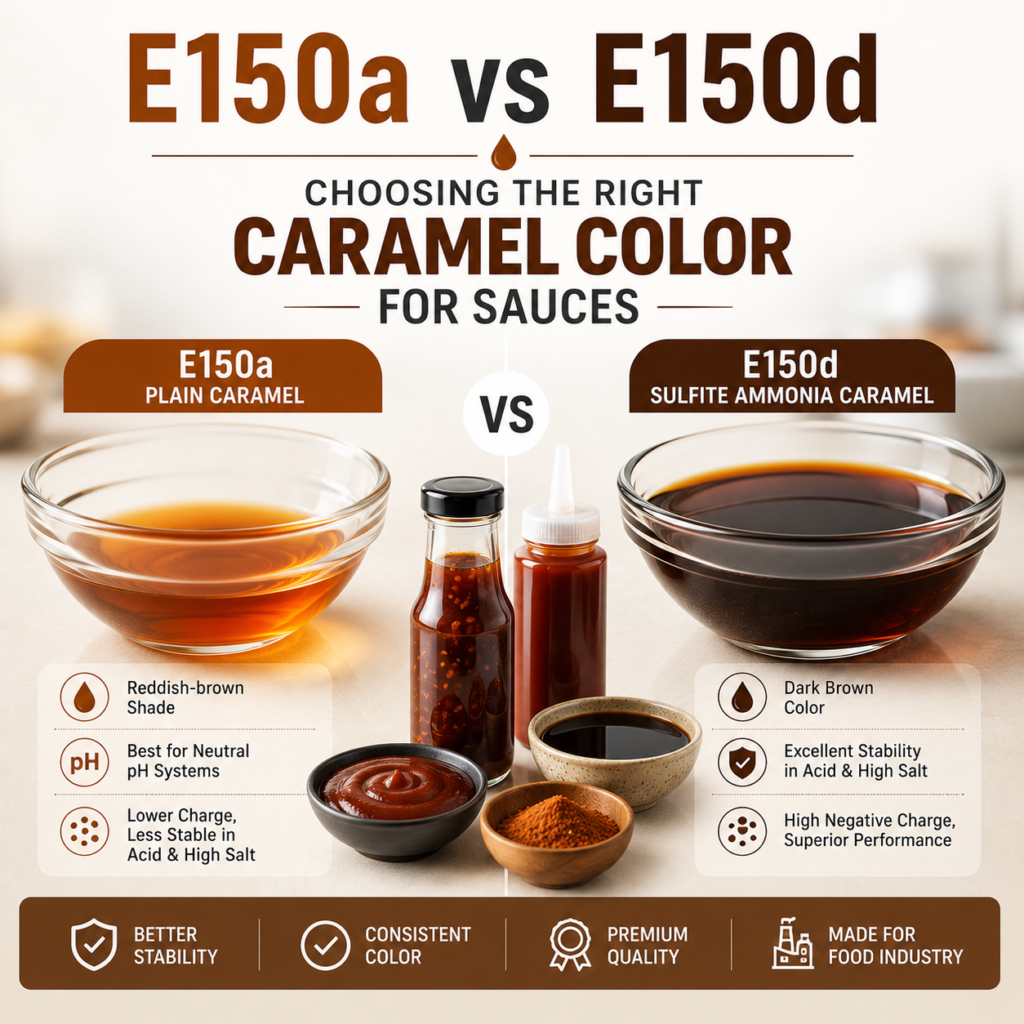
The right caramel color selection is essential. It has a direct impact on the quality and looks of your product. To go with the wrong decision would be to put yourself at risk of color fading, movement, or the formation of sediment. This is what your sauce would go through during its shelf life. Therefore, it can be a potential threat to the brand and create significant financial losses.It is important to realize that, for the majority of the advanced sauce and seasoning formulae, E150d (Sulfite Ammonia Caramel) is a better option. This is attributed to the fact that its chemical structure allows it to be highly stable. However, E150a (Plain Caramel) contains certain properties that allow it to work well in specific applications.The selection of either E150a or E150d is influenced by a number of factors. These consist of variables such as the pH, salt concentration, and the intended method of food processing. By grasping these factors, you will be in a position to make an appropriate choice. The ideal outcome would be to have a stable end-product that is perfect.
Heat and Light: Keeping Colors Unchanged During Processing and Storage
Both E150a and E150d generally exhibit the capacity to withstand heat processing. This includes pasteurization. Nevertheless, the overall strength of E150d contributes an additional safety factor. This is particularly evident in situations where heat is paired with other stressors. Such as, low pH or high salt. A stable color must not only endure production but also the full shelf life. It must withstand the effects of varying light and temperature conditions. E150d has the characteristic of long-term stability.
The choice between E150a and E150d for sauces and seasonings is determined by your individual product formulation.
The case of E150a vs E150d: which is more useful in sauces and seasonings. The choice of E150d is the best one for most formulators.E150d is regarded as a reliable and highly adaptable workhorse. Its ultra-high resistance to acid and high salt lacks E150d is the obvious choice to go for. This applies to most sauces, marinades, and seasonings. It guarantees a long, shiny, and uniform color from the production line to the consumer’s table. E150a is a practical tool that is still available. Nonetheless, it is intended for use in a narrower range of less demanding applications. You can always make the right decision by knowing what your product needs and by persistent testing.