The Simplest Form of Caramel Color
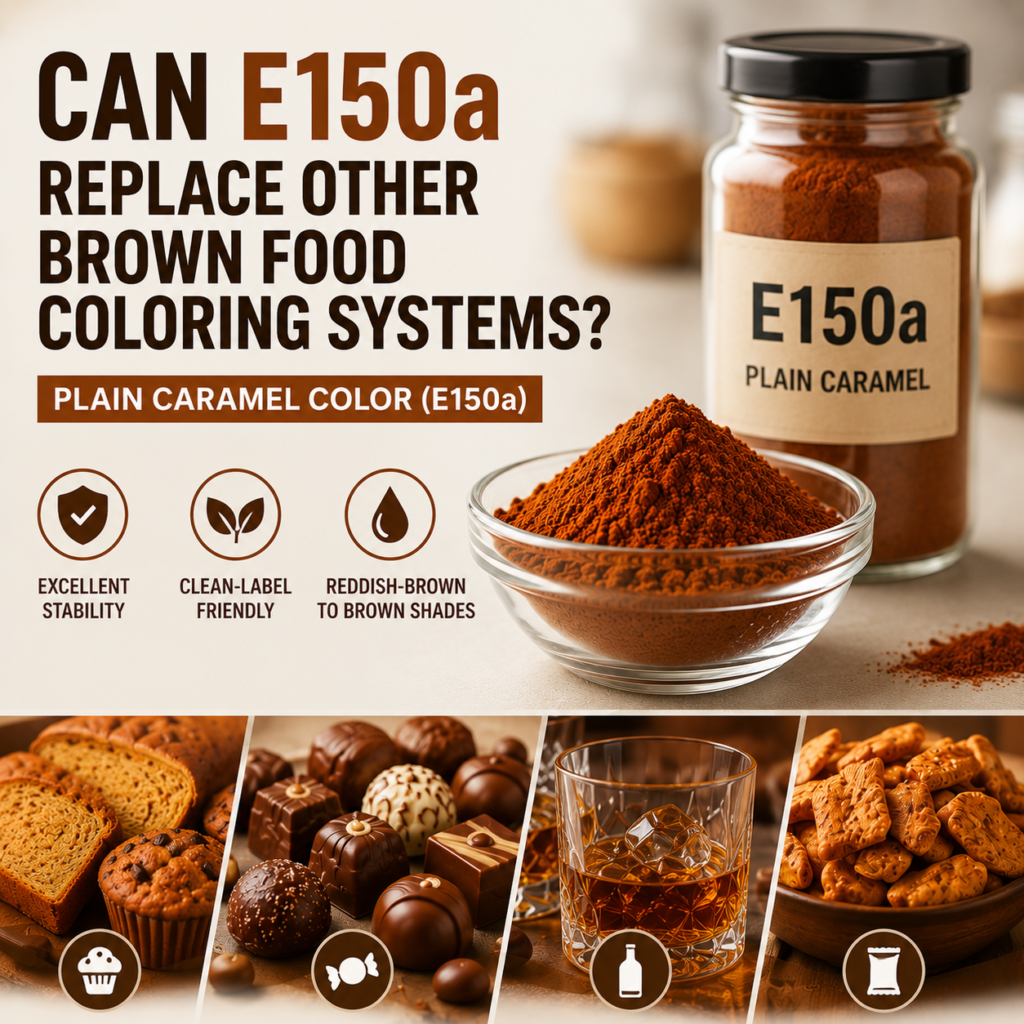
E150a is also called Plain Caramel. It is the result of controlled heating of carbohydrates. These are the simple sugars, glucose, or sucrose.The key point is the production method. Ammonium or sulfite coagulants are not applied in the making of E150a. The application of heat exclusively distinguishes it from the three other types of caramel color.The caramel color E150a is a product of heat treatment with varying shades from yellowish-brown to reddish-brown.
To make a well-informed decision about the suitability of E150a as a substitute, we first explore the other options on the market. Whether E150a is capable to replace your current brown color systems used in food items or not basically relies on what you use at present.
Extra Caramel Colors (E150b, E150c, E150d)
The remaining three classes of caramel are the ones that perform different functions by using reactants to achieve distinct characteristics. For instance, E150b incorporates sulfites. E150c incorporates ammonia, and E150d includes both sulfites and ammonia compounds. These additions contribute to the formation of dark colors and varying spaces of ionic charges. An instance of this would be E150d, which is characterized by having a very strong negative charge. This particular characteristic is the main reason it is very robust in drinks with low pH like cola.Natural Brown Colourants (Non-Caramel)
Many formulators seek to use options that do not include additives. Some of these are malt extract, apple extract, and cocoa powder. These components have the ability to give a brown color. They are said to be “coloring foods” since they contain other nutrients. But they can significantly affect the taste, have reduced color strength, and display different resistances in heat and light. They are considered a clean-label strategy for a Natural Brown Colourants: A Clean-Label Alternative to Caramel plan. But, in comparison to caramel colors, they contrast in function.Artificial Brown Colors
Brown can also be made by the combination of certified colors. The color that results from a mix of FD&C Red #40, Yellow #5, and Blue #1 is the stable brown. These colors are very powerful and dependable. However, they raise serious labeling issues. Many consumers are not interested in artificial colors.Selecting a brown color may be quite complicated sometimes. This table is the one that explains the main performance effects. It allows you to visualize how E150a performs compared to the other products. This is a crucial part of the decision about whether E150a is able to substitute other brown coloring systems in your food products.
The table has it that no specific brown color can be singled out as the best. With the E150d for acidic drinks, we can consider it a clear winner. Its positively charged particle is the key to its stability in that case. Otherwise, E150a is the option for high-alcohol beverages or pastries. The deep reddish-brown is just the right color for them.
Before you start bench testing, run through this mental checklist. These are the same questions we ask when developing a new formulation. After answering them, you will know if E150a can replace your current brown color system.
Check 1: What Is the pH Value of Your Product, and What is the Desired Label?
What you are asking is one of the most pressing inquiries. It is possible that your product has a pH lower than 4.5 and has a dark brown color (for example, in a soft drink). If that is the case, E150d is your best choice in that case, most of the time. E150a can be found in clumps and may not stay in the mix. In this case, however, your goal would probably be to avoid “ammonia-sulfite caramel.” Hence, E150a is the only caramel choice you may have. A lot of forum discussions exist about whether Class 1 caramel is categorized as natural or artificial. E150a is always preferred.Check 2: Does Your Product Have a High Alcohol Content?
If the answer is affirmative, E150a is your most trusted friend. It thrives in spirits with the high proof. That is why it is the major standard color for whiskeys, brandies, and rums. It gives a stable color without causing haze or sediment.Check 3: What Color Do You Want?
The primary consideration is the visual attractiveness. One possible option for a cola beverage or a dark soy sauce is a rich, dark color, which is very close to black-brown. In that case, you cannot get it only by using E150a. What you need is the very high color intensity of E150c or E150d. However, a certain cookie, for example, a bread loaf, and pet food kibble look better with a warmer, reddish-brown. E150a is the best choice here.Check 4: Are you worried about Flavor Impact?
E150a is the colorant with the least flavor profile. It is the most suitable choice if you want to add only color. It will have a minimal effect on your product’s already existing taste. Other caramels, such as E150c, may bring in some not-so-good notes. These could be very suitable for a stout beer but not desired in a light pastry.
After you have concluded that E150a can take the place of the brown coloring system in your food product, the actual job now commences. These are a few suggestions for a hassle-free process.
Benchmarking and Dosage
Very few times do you find a 1:1 replacement. Caramel hues vary in color strengths (tinctorial power). Begin the process with a small dosage of E150a, which is the caramel color. Gradually increase it to the point when the hue of your product is equal to the original product. Write down all measurements carefully and keep visual samples. Stability testing is not optional. You have to first test the formulation in real-world conditions. Additionally, you need to conduct shelf-life studies by exposing the product to harm, light, and any expected pH changes. Before you decide, you need to be sure that the color will not fade, or change, or precipitate over time.
At Qianhe, we understand that consistency is essential in food production. Even a slight color variation between batches can affect the appearance of the finished product and may result in significant production losses.
We provide comprehensive technical support and maintain strict quality control to help ensure reliable batch-to-batch consistency. Our caramel color solutions can be customized according to the specific requirements of your formulation, helping you achieve stable color and dependable performance with every order.
For manufacturers seeking a reliable caramel color partner, we can develop a solution tailored to their product and processing conditions. The key question is whether E150a provides the color, stability, and clean-label positioning required for your specific application.
Based on our discussions, can E150a substitute other brown coloring systems in food products? The conclusion, as we’ve supported, is actually a definitive “it depends.” E150a is a multi-functional and clean-label-friendly additive for any formulator’s toolkit. However, it isn’t the all-in-one solution.
It can act as a substitute in such areas as bakery, alcoholic drinks, and sweets, excellently. Its reddish-brown tint and mild taste are important benefits in these products. A direct answer would be it is not suitable to enter high-acid soft drinks with E150d which needs the unique stability it gives. The road to success is primarily found through a thorough examination of both the technical specification of your product and the marketing goals of your brand.