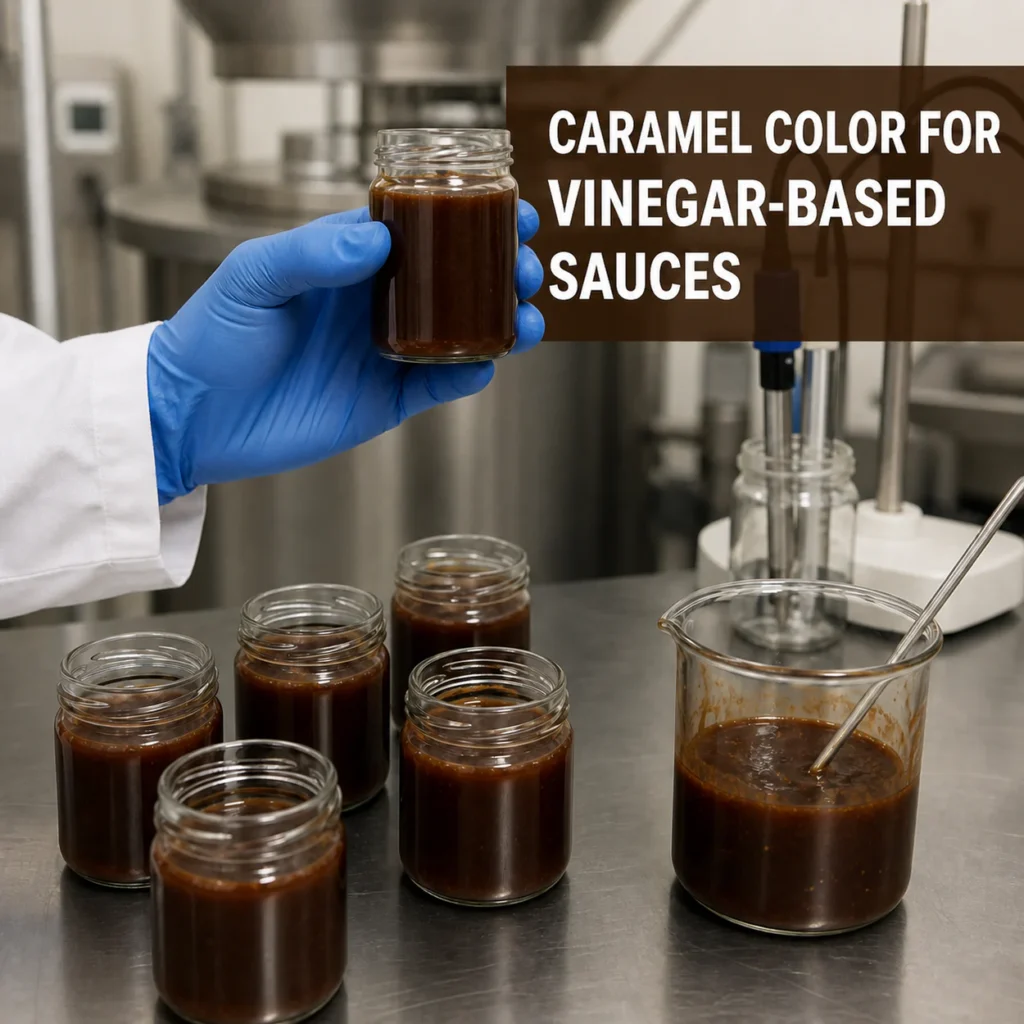
Quick answer: For a vinegar-based sauce, caramel color should be selected through a factory-relevant trial, not from a generic dark-sauce reference. The team needs to assess the candidate in the actual acid, salt, sugar and flavour system; repeat the check after normal processing; and keep a traceable record that connects the chosen grade, dosage, package and supplier documents.
This guide is for sauce manufacturers, seasoning producers, private-label buyers and foodservice suppliers developing vinegar-based sauces, dipping sauces, barbecue-style sauces or acidified condiments. It does not declare that a particular caramel-color class or grade will work in every sauce. The final decision must be based on the real formula, process, customer specification and target-market requirements.
Why vinegar-based sauces need their own qualification plan
A vinegar-based sauce is more than an acidic liquid. Its visual appearance can be shaped by the acid system, salt, sugar, spices, starches, gums, particulates, heating profile, filling conditions and package. A sample that looks appropriate in a diluted model may give a different result once the complete sauce is blended, cooked, rested and packed.
The buyer’s first task is therefore to define the application accurately. "Sauce" is too broad for a technical request. A thin dipping sauce, a viscous barbecue-style sauce and an emulsified table condiment may have very different processing steps and visual risks. An inquiry should identify the product type, target shade, intended market, current process and the point at which the colorant will be introduced.
Write a supplier brief that can be tested at the plant
Before requesting a sample, create a short trial brief that follows the product rather than the supplier catalogue. It should be detailed enough for the product-development and quality teams to run the same test, but it does not need to disclose proprietary flavour details.
- Product description and target market or customer segment.
- Target visual standard: shade, uniformity, gloss or other agreed appearance criteria.
- Approximate pH range, acid source, salt level and the presence of sugar, starch, gums or particulates.
- Process sequence: blending, cooking, pasteurisation, holding, cooling, filling and any filtration.
- Package type, expected shelf life and relevant storage or distribution conditions.
- Supplier documentation required before commercial approval.
Where the manufacturer already has a benchmark sauce, include a retained reference sample and define how the trial sample will be compared. If the customer uses an instrument-based colour standard, include that method in the brief. If the decision is visual, agree the lighting and viewing conditions so that different reviewers do not judge the product in different ways.
Confirm product identity and documentation before scaling the trial
Do not move directly from an email description of "caramel color" to a factory trial. Confirm the exact proposed grade, physical form, sample batch and document version. The TDS, COA, sample label and quotation should tell the same product story. Any difference in identity, concentration, carrier or handling instruction needs clarification before the plant treats two samples as comparable.
For an overview of caramel-color classifications, see Qianhe’s Caramel Color Class I-IV article. It is useful for terminology, but it does not determine compliance or performance for an individual sauce. Your regulatory and quality teams must assess the finished food category and the target market, while R&D must assess the formula and process.
Use a three-level factory trial plan
A staged protocol prevents a large-scale test from being wasted on a sample that already fails at bench scale. It also makes it possible to locate the stage at which an appearance change begins. The exact test conditions should follow your own product and quality system, but the structure below is a practical starting point.
| Trial level | Purpose | What to compare | Release decision |
|---|
| Bench batch | Screen the candidate in the full sauce base. | Target shade, uniformity, addition order, initial appearance. | Advance only candidates that meet the agreed initial target. |
| Pilot or process simulation | Represent critical factory steps. | Before/after heating, holding, cooling and any filtration or homogenisation. | Hold samples with unexplained process-related changes. |
| Pack and storage check | Confirm the finished visual result in the commercial format. | Pack appearance, settled material, shade consistency and agreed check dates. | Approve only with a complete technical and document record. |
At bench scale, use the complete acid, salt, sugar and flavour system. Adding caramel color to a plain vinegar-water mix may be useful for an early screen, but it is not a substitute for testing the finished sauce base. Record the order in which materials are added, the sample batch, the dose, the mixing method and any pre-dilution used. Those records are essential when a result needs to be repeated.
At pilot scale, choose the product operations most relevant to the sauce. These may include heating, a defined holding time, cooling, pumping, filtration, deaeration or filling. Compare a control with each candidate under the same conditions. If the color is used in a product that may be reheated by a foodservice customer, decide whether that use scenario belongs in the qualification protocol rather than assuming the factory process alone is sufficient.
Evaluate pH stability as a finished-system question
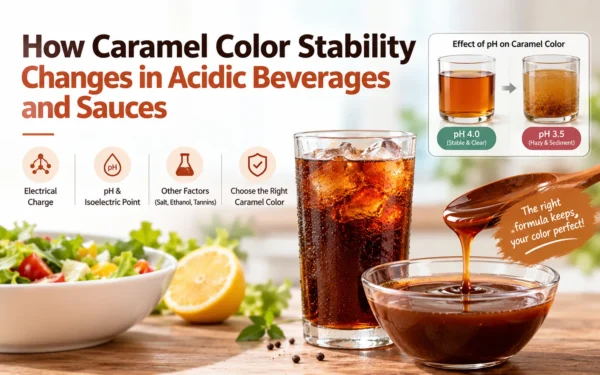
"pH stability" is often used as a shortcut, but the operational question is more precise: does the finished sauce meet its agreed visual standard after the defined formula, process and storage conditions? pH should be recorded, because it is a relevant part of the system, but it should be reviewed together with all the other variables that make the sauce different from a test solution.
If a sample changes appearance, do not label it a colorant failure immediately. Review whether the formula version, ingredient lots, water, temperature history, process order, package or storage condition changed between the control and the trial. The objective is to identify the condition that needs control. This avoids an unproductive loop in which purchasing requests new samples without the development team gaining a repeatable answer.
Bring procurement, quality and R&D to the same approval point
Technical performance alone is not a complete supplier qualification. Before commercial release, confirm a current TDS, representative COA, storage and shelf-life information, packaging data, traceability details and any destination-market declarations required by your regulatory team or customer. A generic statement online does not prove that the proposed batch meets a buyer’s specification.
Use Qianhe’s caramel color page or liquid caramel color page to identify the broader product category when preparing an inquiry. Ask for a response tied to the selected material and the customer’s requirements; do not infer a particular packaging option, MOQ, certification or lead time from a generic page.
Make the commercial comparison on a validated basis
For candidates that pass the technical checks, compare cost in use rather than only the quoted price. Record validated dosage, output per batch, pack size, loss or adjustment expected in production, document turnaround time, minimum order conditions and quality-control workload. A lower price per kilogram can be misleading if the approved production result requires more material or introduces more variability.
Capture the final approval in a controlled record. It should include the exact grade, supplier and sample batch; sauce application; target shade; accepted dosage range; process scope; package; storage checks; document versions; and requalification triggers. Reopen the review if there is a material change to the acid system, formula, factory process, package, supplier grade or export market.
FAQ
Can a sample approved for soy sauce be transferred directly to a vinegar-based sauce?
Not automatically. The acid system, solids, process and visual target may differ. Use the prior result as background information, then test the material in the actual vinegar-based sauce formulation.
What should be compared after heating?
Compare the trial and control against the agreed shade and uniformity standard, then record any visible sediment, ring formation, separation, unexpected change or process-related variation under the same conditions.
When is a factory trial ready for supplier approval?
When the defined technical result is acceptable, the product identity is traceable, required documents are complete, the target-market review is complete and the approval record states what was actually tested.
References for regulatory-review stage
Next step: Use the three-level protocol for the next vinegar-based sauce sample and keep the trial brief with the COA and TDS. It converts a colour sample into a documented purchasing decision.