Choosing the right brown coloring ingredient can be challenging for food manufacturers. With so many options available, it’s important to consider not only color and cost, but also stability, flavor, and labeling requirements. Can E150a (Plain Caramel Color) replace other brown coloring systems in food products? The answer depends on the application. While E150a works well in certain foods and beverages, it may not provide the same performance as other caramel colors or brown colorants. This guide explores the key differences, suitable applications, and important factors to consider before making the switch.
First, A Quick Refresher: What Exactly is E150a Plain Caramel?
In order to figure out which other brown colors E150a can replace, we first have to understand it. E150a is the most basic of the four distinct classes of caramel color.
The Simplest Form of Caramel Color
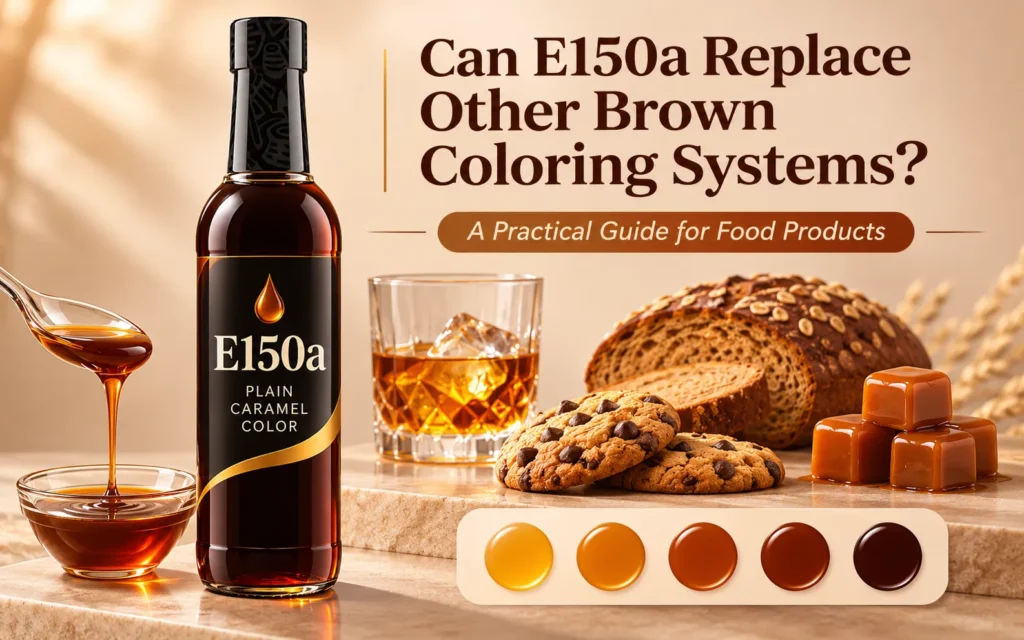
E150a is also called Plain Caramel. It is the result of controlled heating of carbohydrates. These are the simple sugars, glucose, or sucrose.
The key point is the production method. Ammonium or sulfite coagulants are not applied in the making of E150a. The application of heat exclusively distinguishes it from the three other types of caramel color.
The caramel color E150a is a product of heat treatment with varying shades from yellowish-brown to reddish-brown.
Technical Properties At a Glance
The essential characteristics every formulator should be aware of are:
- Ionic Charge: It has a slight negative colloidal charge. This influences its effect on other components in your product.
- Labeling as “Clean”: As it is made with only heat and sugar, E150a is always thought of as a more “clean” variant. It adheres to the concern of customers about artificial chemicals in their diet.
- Flavor Profile: E150a has a sweet and mild flavor. The caramel sugar is slightly burnt, as some claim but is muted compared to other caramel colors.
The Brown Spectrum of Colors: Alternatives to E150a
To make a well-informed decision about the suitability of E150a as a substitute, we first explore the other options on the market. Whether E150a is capable to replace your current brown color systems used in food items or not basically relies on what you use at present.
Extra Caramel Colors (E150b, E150c, E150d)
The remaining three classes of caramel are the ones that perform different functions by using reactants to achieve distinct characteristics. For instance, E150b incorporates sulfites. E150c incorporates ammonia, and E150d includes both sulfites and ammonia compounds. These additions contribute to the formation of dark colors and varying spaces of ionic charges. An instance of this would be E150d, which is characterized by having a very strong negative charge. This particular characteristic is the main reason it is very robust in drinks with low pH like cola.
Natural Brown Colourants (Non-Caramel)
Many formulators seek to use options that do not include additives. Some of these are malt extract, apple extract, and cocoa powder. These components have the ability to give a brown color. They are said to be “coloring foods” since they contain other nutrients. But they can significantly affect the taste, have reduced color strength, and display different resistances in heat and light. They are considered a clean-label strategy for a Natural Brown Colourants: A Clean-Label Alternative to Caramel plan. But, in comparison to caramel colors, they contrast in function.
Artificial Brown Colors
Brown can also be made by the combination of certified colors. The color that results from a mix of FD&C Red #40, Yellow #5, and Blue #1 is the stable brown. These colors are very powerful and dependable. However, they raise serious labeling issues. Many consumers are not interested in artificial colors.
Selecting a brown color may be quite complicated sometimes. This table is the one that explains the main performance effects. It allows you to visualize how E150a performs compared to the other products. This is a crucial part of the decision about whether E150a is able to substitute other brown coloring systems in your food products.
| Feature | E150a (Plain Caramel) | E150c / E150d (Ammonia / Sulfite-Ammonia) | Natural Extracts (e.g., Malt) | Artificial Blends |
|---|
| Color Hue & Intensity | Yellow to Reddish-Brown, Mild Intensity | Red-Brown to Deepest Dark Brown, High Intensity | Variable Brown, Varies by Source | Consistent Dark Brown, High Intensity |
| pH Stability | Good in neutral pH; Poor below pH 2.5 | Excellent in low pH (E150d); Good in neutral (E150c) | Variable, generally less stable than caramel | Excellent across a wide pH range |
| Alcohol Stability | Excellent | Poor to Good (depends on class) | Poor to Fair | Excellent |
| Salt Stability | Good, but requires high-quality sourcing | Good | Fair to Poor | Excellent |
| “Clean Label” Status | Favorable (E-Number) | E-Number | Very Favorable (Ingredient, not Additive) | Poor (Certified Colors) |
| Cost (General) | $ | $$ | $$$ | $$ |
| Best-Fit Applications | Spirits, Baked Goods, Confectionery, Pet Food | Colas, Soy Sauce, Beer, Gravies, Soups | Baked Goods, Cereals, Beverages | Confectionery, Dry Mixes |
Results Explanation from Expert Perspective
The table has it that no specific brown color can be singled out as the best. With the E150d for acidic drinks, we can consider it a clear winner. Its positively charged particle is the key to its stability in that case. Otherwise, E150a is the option for high-alcohol beverages or pastries. The deep reddish-brown is just the right color for them.
Stably achieving that is quite a difficult task. A good example of this is found in difficult products such as brines or sauces. Our “High-Salt Dilute Authenticity Brew鈩? method was created for this reason. It is the way our caramel colors survive the tough environments like high-salt, retain their authenticity, and stay true to the original hue. This highlights the selection of both the supplier and the right class as very critical factors.
A Formulator’s Checklist: When to Choose E150a
Before you start bench testing, run through this mental checklist. These are the same questions we ask when developing a new formulation. After answering them, you will know if E150a can replace your current brown color system.
Check 1: What Is the pH Value of Your Product, and What is the Desired Label?
What you are asking is one of the most pressing inquiries. It is possible that your product has a pH lower than 4.5 and has a dark brown color (for example, in a soft drink). If that is the case, E150d is your best choice in that case, most of the time. E150a can be found in clumps and may not stay in the mix. In this case, however, your goal would probably be to avoid “ammonia-sulfite caramel.” Hence, E150a is the only caramel choice you may have. A lot of forum discussions exist about whether Class 1 caramel is categorized as natural or artificial. E150a is always preferred.
Check 2: Does Your Product Have a High Alcohol Content?
If the answer is affirmative, E150a is your most trusted friend. It thrives in spirits with the high proof. That is why it is the major standard color for whiskeys, brandies, and rums. It gives a stable color without causing haze or sediment.
Check 3: What Color Do You Want?
The primary consideration is the visual attractiveness. One possible option for a cola beverage or a dark soy sauce is a rich, dark color, which is very close to black-brown. In that case, you cannot get it only by using E150a. What you need is the very high color intensity of E150c or E150d. However, a certain cookie, for example, a bread loaf, and pet food kibble look better with a warmer, reddish-brown. E150a is the best choice here.
Check 4: Are you worried about Flavor Impact?
E150a is the colorant with the least flavor profile. It is the most suitable choice if you want to add only color. It will have a minimal effect on your product’s already existing taste. Other caramels, such as E150c, may bring in some not-so-good notes. These could be very suitable for a stout beer but not desired in a light pastry.
Transitioning: Helpful Hints for Successful Implementation
After you have concluded that E150a can take the place of the brown coloring system in your food product, the actual job now commences. These are a few suggestions for a hassle-free process.
Benchmarking and Dosage
Very few times do you find a 1:1 replacement. Caramel hues vary in color strengths (tinctorial power). Begin the process with a small dosage of E150a, which is the caramel color. Gradually increase it to the point when the hue of your product is equal to the original product. Write down all measurements carefully and keep visual samples.
Stability testing is not optional. You have to first test the formulation in real-world conditions. Additionally, you need to conduct shelf-life studies by exposing the product to harm, light, and any expected pH changes. Before you decide, you need to be sure that the color will not fade, or change, or precipitate over time.
Finding a trusted partner. Uniformity is the essence of food production. A mere customer with a slight color deviation from your supplier may cause you to lose an entire batch of your product. It is essential to work with a provider who offers not only comprehensive technical support but also guarantees batch-to-batch consistency. For instance, formulators who seek such consistency can consider Canon Caramel Color Qianhe. It can be a pre-design for your specific product’s needs. Every order would be reliable with it.
Final thought is E150a your ideal substitute?
Based on our discussions, can E150a substitute other brown coloring systems in food products? The conclusion, as we’ve supported, is actually a definitive “it depends.” E150a is a multi-functional and clean-label-friendly additive for any formulator’s toolkit. However, it isn’t the all-in-one solution.
It can act as a substitute in such areas as bakery, alcoholic drinks, and sweets, excellently. Its reddish-brown tint and mild taste are important benefits in these products. A direct answer would be it is not suitable to enter high-acid soft drinks with E150d which needs the unique stability it gives. The road to success is primarily found through a thorough examination of both the technical specification of your product and the marketing goals of your brand.
Frequently Asked Questions (FAQ)
1. Is E150a a “clean label” ingredient?
E150a is usually involved in the production of detergent “clean label” products. It is formed without the presence of ammonia or sulfite reactants. Nevertheless, it is still an E-number. For some brands that prefer the “ingredient” color concept, alternatives such as malt or fruit extracts are available. In this way, they avoid an additive declaration.
2. Is it possible for me to substitute E150a for E150d in my cola drink?
This is generally not advisable. As colas are very acidic. They need the strong negative ionic charge of E150d (Sulfite Ammonia Caramel) for their stability. Introducing E150a in such a setting would probably bring about difficulties. The pigment may clump up and form precipitate, or quickly turn to fade.
3. What is the main difference in the taste of E150a and the other caramels?
E150a is the one that has the least flavor in most cases. Its profile is often characterized by sweet and slightly toasty notes. E150c and E150d can have more distinctive bitter or burnt notes. This is due to the reactants involved in their production. In some applications, such as stout beer, this can be desired. But it is not desired in others.
4. Is E150a suitable for use in alcoholic beverages like whiskey?
Yes, E150a is a very good choice for high-proof spirits. It is very stable in the presence of alcohol. Its efficiency has been widely used in the standardizing of the color of whiskeys, brandies, and rums. It does so without largely making changes to the flavor profile.