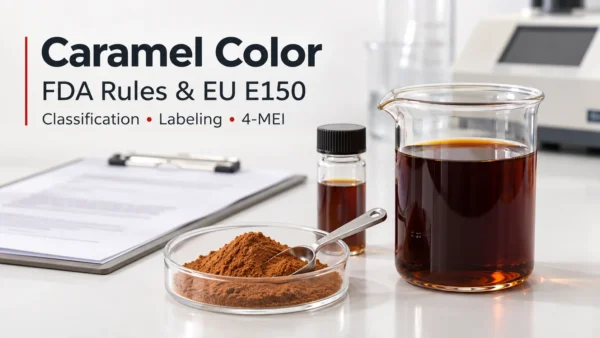
For food manufacturers and ingredient importers, selecting caramel color involves more than matching a shade. Before approving a supplier grade, check its permitted use, manufacturing identity, labeling requirements and supporting analytical data.
This guide explains the U.S. and European Union requirements that matter when sourcing caramel color for commercial food production.
Is Caramel Color Banned in Europe?
There is no blanket ban on caramel color in the European Union: E150a, E150b, E150c and E150d are authorized subject to food-category conditions.
These additives appear in Annex II of Regulation (EC) No 1333/2008. Authorization depends on the finished food and the conditions attached to its category. Before approving a formulation:
- Identify the food category covering your finished product.
- Check whether the selected caramel class is permitted.
- Confirm the maximum level, restrictions and relevant footnotes.
Where the permitted level is quantum satis, no numerical maximum is specified. Follow good manufacturing practice, use only the amount needed for the intended coloring effect and avoid misleading consumers. Regulation (EC) No 1333/2008
California Proposition 65 warnings and EU food-additive authorization address different regulatory questions. The 4-MEI section below explains the distinction between additive specifications and exposure-based warning assessments.
These EU rules do not establish the requirements for every European country. Check the United Kingdom and Switzerland separately when supplying those markets.
Caramel Color FDA Requirements
FDA permits caramel color under 21 CFR §73.85 when the additive meets the prescribed identity, specifications and conditions of use.
For U.S. applications, review four points:
- Identity and composition: Confirm that the grade meets the regulation’s definition and requirements for manufacturing substances and impurities.
- Intended use: Use caramel color in accordance with good manufacturing practice. For foods with a standard of identity, confirm that the standard permits added color.
- Batch certification: Caramel is exempt from FDA color-additive batch certification. It must still meet the applicable specifications.
- Bulk labeling: Check that the supplied additive or color mixture carries the required identification, composition information and applicable use restrictions. 21 CFR §73.85; 21 CFR §70.25
Ask the supplier to identify the regulation supporting its compliance statement and the specific grade covered. Record your intended food application and use level alongside that documentation.
What Is E150 Caramel Color?
E150 caramel color is a family of four classes distinguished by the use of ammonium and sulphite compounds during manufacture.
Use the complete E number to identify the class:
Swipe horizontally to view the full table.
| Class | E number and name | Manufacturing distinction |
|---|
| I | E150a — Plain caramel | Neither ammonium nor sulphite compounds |
|---|
| II | E150b — Caustic sulphite caramel | Sulphite compounds; no ammonium compounds |
|---|
| III | E150c — Ammonia caramel | Ammonium compounds; no sulphite compounds |
|---|
| IV | E150d — Sulphite ammonia caramel | Both ammonium and sulphite compounds |
|---|
The specifications also permit certain acids, alkalis and salts. “Plain caramel” therefore does not necessarily mean a product manufactured using only sugar and heat. Regulation (EU) No 231/2012
The E number identifies the class; the supplier’s grade code and technical specification identify the product to order. Grades within one class can differ in color strength, pH and application performance.
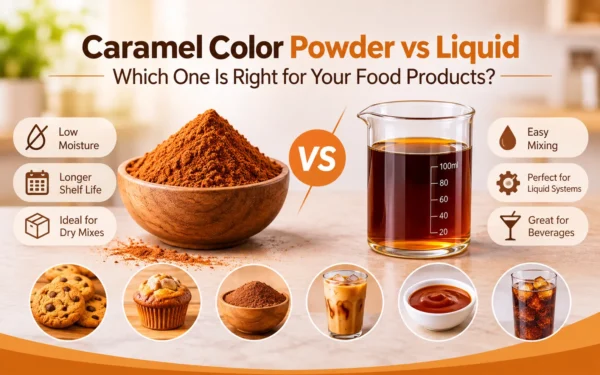
When sourcing E150 caramel, specify the required class, liquid or powder form, color-strength method and processing conditions. Evaluate samples in your actual formulation before confirming the grade. For more background, see our caramel color Class I–IV guide.
How Is Caramel Color Declared on Food Labels?
U.S. labels can identify caramel color by name or a permitted general color declaration; EU ingredient lists generally require the functional category followed by the specific name or E number.
Swipe horizontally to view the full table.
| Market | Declaration approach | Example |
|---|
| United States | Name or permitted general color term | Caramel color |
|---|
| European Union | Functional category plus E number | Colour: E150d |
|---|
| European Union | Functional category plus specific name | Colour: sulphite ammonia caramel |
|---|
FDA does not generally require the ingredient statement to identify caramel color as Class III or Class IV. FDA labeling explanation
For EU labels, use the correct additive identity and destination-market language, taking account of applicable exemptions. Sulphite allergen disclosure requires a separate assessment: the threshold is more than 10 mg/kg or 10 mg/litre, expressed as total SO2 in the food ready for consumption or reconstituted as instructed. Regulation (EU) No 1169/2011
Assess contributions from all ingredients and use testing where needed to confirm the result. The caramel class alone does not determine whether the finished food crosses this threshold.
What Are the 4-MEI Limits for Caramel Color?
EU 4-MEI limits apply to caramel additive specifications, while California uses a daily-exposure benchmark; FDA’s §73.85 contains no numerical 4-MEI limit.
4-MEI means 4-methylimidazole. Keep the following regulatory benchmarks separate:
Swipe horizontally to view the full table.
| Framework | Value or status | Basis |
|---|
| EU — E150c | Maximum 200 mg/kg | Equivalent-color basis |
|---|
| EU — E150d | Maximum 250 mg/kg | Equivalent-color basis |
|---|
| FDA — §73.85 | No numerical 4-MEI limit specified | FDA review remains relevant |
|---|
| California Proposition 65 | 29 µg/day NSRL | Daily exposure for warning assessment |
|---|
The EU values are normalized to a product with a color intensity of 0.1 absorbance units. They are specifications for the additive, rather than maximum concentrations in a finished beverage or sauce. Confirm the reporting basis before comparing a supplier’s result with these limits. EU caramel color specifications
California’s 29 µg/day value is a No Significant Risk Level, used as a safe-harbor exposure level in Proposition 65 warning assessments. A concentration result in ppm cannot be compared directly with this daily amount. An exposure assessment also needs the ingredient use level and estimated food consumption. OEHHA: 4-Methylimidazole
FDA’s review list, dated May 12, 2026, identifies potential safety concerns involving 4-MEI levels in Class III and IV caramel colors. The agency is seeking information on current levels and manufacturing controls. Request current analytical evidence and track regulatory updates. FDA chemicals under review
For any “low 4-MEI” purchasing requirement, agree on a numerical maximum, reporting basis and test method. If a result states “not detected,” request the detection limit or limit of quantification.
Can One Caramel Color Grade Serve U.S. and EU Products?
One grade can serve both markets when it meets each market’s requirements for the intended food, use level and label.
Create a separate approval record for each finished product and destination. Record the supplier grade code, formulation dosage, applicable food category, specification results and approved ingredient declaration.
For California distribution, include the relevant exposure assessment and customer requirements. Reassess the approval when the supplier changes the grade’s composition or manufacturing process, or when your formulation, dosage or destination market changes.
Which Documents Should Buyers Request?
Request technical specifications, batch evidence, regulatory information and commercial terms before approving a supplier grade.
Use these four groups as a purchasing checklist:
- Technical datasheet — TDS. Confirm the class, grade code, liquid or powder form, color-strength method, pH and relevant application properties. Include viscosity or solubility information where it affects production.
- Certificate of analysis — COA — and supporting test reports. Check the batch identity, specification limits, actual results and test dates. For 4-MEI, request the method, units, reporting basis and quantification limit.
- Regulatory, composition and allergen information. Request a statement identifying the destination market and grade covered. Obtain information on ingredients, carriers and allergens needed to assess the finished product and its label.
- Commercial and supply specifications. Confirm packaging, storage conditions, shelf life, MOQ, sample availability and lead time. Request relevant certificates and verify their scope and validity.
Compare quotations against the same agreed specification. Use our caramel color TDS and COA review checklist to organize the supplier review.
Request Caramel Color Specifications for Your Target Market
To request a suitable caramel color grade, provide your destination market, finished-food application and technical requirements.
Explore Qianhe caramel color products and include the following details in your inquiry:
- Target country and finished-food application.
- Preferred class, liquid or powder form, and intended use level.
- Required color performance and any customer-specific 4-MEI specification.
- Estimated order quantity, packaging needs and required delivery date.
Contact Qianhe to discuss available grades and request technical documents, sample information and a quotation. Specify the documents your technical team needs so the proposed grade can be reviewed before a bulk order.
Regulatory sources reviewed:
.
Have your regulatory team confirm the final formulation, intended market and label before commercial release.