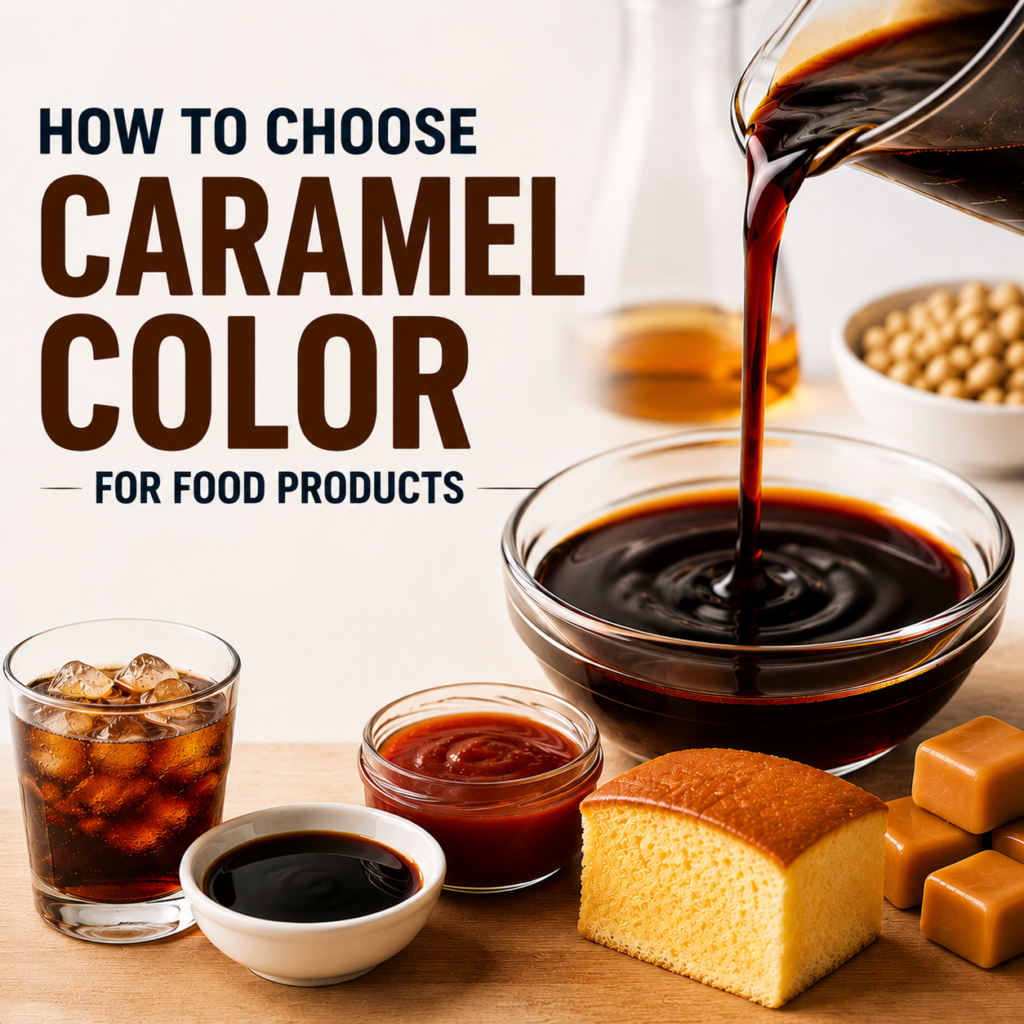
Selecting the appropriate caramel color for your food or beverage product goes beyond merely deciding on a shade of brown. It is a pivotal decision that affects your product’s appearance, stability, labeling, and consumer safety. Incorrect selection not only leads to costly product modifications and rejected batches but also damages your brand. Thus, what should food manufacturers verify before purchasing caramel color?
The very first step to producing caramel color is grasping the four-class system fully. This is the primary ground for the following steps. Each class is uniquely produced, and they behave differently in food systems. Making the right selection at the start is the key to avoiding major difficulties later on.This system is accepted by the whole world as it is. It helps you to ensure that you have chosen a color that is effective and also a legal requirement for your product. A thorough analysis of food caramels shows these classes are standard based on what was applied during the production.
The charge is a key. It signifies the interaction of caramel color bits with other ingredients in your product. Next, we are going to focus on this.
You have already garted the right class; you need the technical details next. A caramel color’s spec sheet serves as its performance map. The understanding that food manufacturers need to technically check the caramel color before the purchase is crucial for the product’s success.
Color Intensity (Tinctorial Power)
Color intensity is the measure of how potent the color is. In most cases, this measurement is taken in a lab at a specific light wavelength.Higher color strength signifies that you need to add less of the ingredient to reach the desired shade. This has an effect on the cost in use directly. A more deeply saturated color can be more cost-effective even though its price on the market is higher.pH and Its Effect on Stability
The pH of your food product and caramel color should be at the same level. Caramel color can be unstable when there is a significant difference between them.This can result in color precipitation, for instance, when you see the color falling out of the solution. It can also be a source for gradual color shift over the whole shelf life of the product. Always check the pH range of the caramel on the spec sheet and then compare it to the pH of your product.Ionic Charge (A Deeper Dive)
We have previously discussed the charge, but it again deserves a special emphasis. This property is the decisive factor that will determine whether the caramel color will stay dissolved or will bond with other molecules in your product.As a prime example, a positive-charge Class III caramel in a drink with a negative-charge of tannins can cause the drink to precipitate and haze. This is a typical act that one does, but it can be avoided. The positive and negative particles pull each other close and as a result, they make a cloudy mess. This is the reason that negative-charge Class IV caramels are mainly used in the soft drink sector.The caramel color that you procure needs to be safe and legal for your target market. It is imperative for you to conduct this vital check. Compliance is not a matter of choice. This is one of the most vital checks that a food manufacturer can make. Caramel color that is safe and legal for your particular intended market is one of the checks that the manufacturer must ensure.Knowing 4-MeI (4-Methylimidazole)
4-MeI is a compound that can be produced during the processing of Class III and Class IV caramels with the use of ammonia. Recently, this topic has been of regulatory concern.California’s Proposition 65 has ruled out any 4-MeI levels higher than the specified limit. Consequently, the industry has come up with the idea of “low 4-MeI” and even “ultra-low 4-MeI” options. It’s worth mentioning that international regulatory authorities have conducted extensive studies on the safety of caramel color and have categorized it as safe when certain specifications are met. Prominent organizations such as the FDA and EFSA have determined adequate amounts for daily consumption. Therefore, it is advisable to always request a 4-MeI statement from your suppliers in order to make sure that you are complying with the regulations.Allergen and GMO Status
Caramel color is usually produced from carbohydrates such as corn but it can also be from wheat or other sources. To manage allergen labeling, it is necessary to examine the source.Get your supplier to assist you by issuing definite, written statements on common allergens (e.g. wheat, soy, or dairy ) and the GMO status of raw materials.International Compliance
The approach to food safety regulations varies greatly from region to region; for example, the European Union, the United States, and Asia. What might be good in one country, could be the opposite in another. Therefore, it would be beneficial to choose a supplier who has a good handle on these international disparities, and can also provide the necessary documentation across all target markets.
Apart from the product, it’s essential to take a look at the manufacturer. A suitable supplier is not just a vendor. They are a collaborator in the prosperity of your product. This is the main factor that food manufacturers should consider about caramel color.
Inquire About Lot-to-Lot Consistency
A perfect sample is obsolete if the supplier cannot deliver the same quality with every single order. Color which varies can spoil the appearance of your end product and harm consumer loyalty.Pose direct questions to potential suppliers: “How do you control the process to ensure that the color intensity and pH balance are the same from one batch to the next?” A reputable manufacturer will have standardized systems in place and will be able to provide supportive data for their statements.Consider Technical Support and Expertise
What if you encounter a problem? A good supplier’s team consists of experts who assist you with troubleshooting. They should be well-versed in your specific process and capable of providing useful suggestions.Only the right supplier can show the know-how of the specific caramel which not to flocculate or turn color under high salt and special processing conditions. The authentic knowledge is, thus, a solid indicator of a good partner.Requesting a Plant Audit or a Quality Systems Overview
Transparency is the most prominent indicator of a reliable supplier. The first step is to verify their quality certifications obtained from recognized organizations like the Global Food Safety Initiative (GFSI), ISO, or other third-party auditors. A manufacturer that is confident about their facility, equipment, and processes would be more than willing to provide this information.
Before the public purchase order is signed, there are only two more acted steps: a document that is completely checked, and a hands-on test.
Include the Benchtop Trial as a MUST
A specification sheet alone is never enough to build trust. The ultimate and most decisive test is to manufacture and analyze your own product with your own.Allot the sample to your product base. Watch for the immediate problems, such as cloudiness, the separation, and clumping. Then do a quick, shelflife test. Besides testing your product to heat and light, show the effect on color over time. Just one little test can save you from a big production disaster.