When you are a product creator, it is very possible for you to undergo the circumstances that are experienced by the majority of the product developers. You mix all the right shades of colors and get an exact approximation of the drink’s or sauce’s color you are after. Gradually, you feel something is wrong, after some time, you discover the problem. You see a cloudy haze, a nasty ring of sediment, or a faded color that is totally the opposite of what you created. This issue arises frequently but it is very bothersome. The crucial point to avoiding it is to apprehend the alterations that caramel color stability undergoes in acidic beverages and sauces.
Introduction: The Problem of Inconsistent Colors
How Good Colors Can Be Bad in Acidic Conditions
It is something like hazing that you can see in a transparent soda. You may spot the sediment at the bottom of your salad dressing. You may notice that the marinade is completely washed out because of the color. These-type of apparently lost biodegradable displays are not mere cosmetic vexations. They are warnings about weakening the product and destroying consumer trust.
In the drinks and food sector, this is a very common and expensive problem. The good news is that it can be avoided completely through proper training.
The Contents of This Guide
This guide goes beyond just telling the problem. We will study caramel color’s stability in acidic beverages and sauces through the lens of science. Even more significant, we will provide a guide that is really useful in everyday work. With it, you will choose the right ingredient and thus your product will be perfect from start to end.
What Causes the Unstable?: Acidity and Its Effect on Caramel Color
The Basic Principle: Electrical Charge
The caramel color’s stability is conditional on its microscopic components’ dimensionality. The entities in question are colloids. Such small particles get suspended in a liquid due to their highly dispersed characteristics. Each particle has an electrical charge that is detrimental or positive.
Envision them as minute magnets that are suspended in your product. As all the magnets have the same charge, they tend to repel one another. The repulsion is what keeps them evenly distributed in a perfect way. This leads to a uniformly colored, transparent product.
The Connection of pH and Isoelectric Point
The acidity of your product is being evaluated by its pH. It has a direct influence on this electrical charge. All kinds of caramel colors have an “isoelectric point.” This term refers to the exact pH at which their parts receive no electrical charge anymore, thus becoming neutral.
Imagine what occurs when the “magnets” are turned off? They not only cease to repel each other but also, they tend to clump. This type of small-scale aggregation is called flocculation. Such clumps are generally too massive to remain suspended. Consequently, they precipitate out of the solution giving rise to the haze, and the sediment which you wish to avoid.
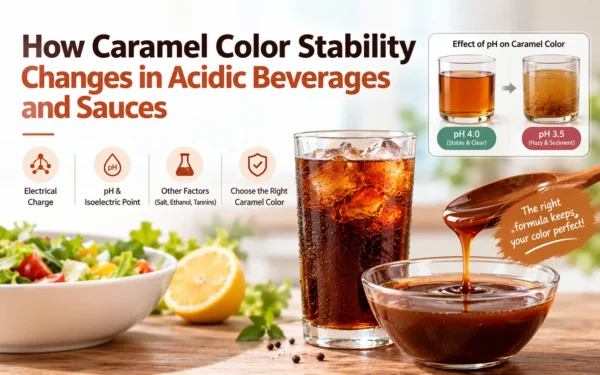
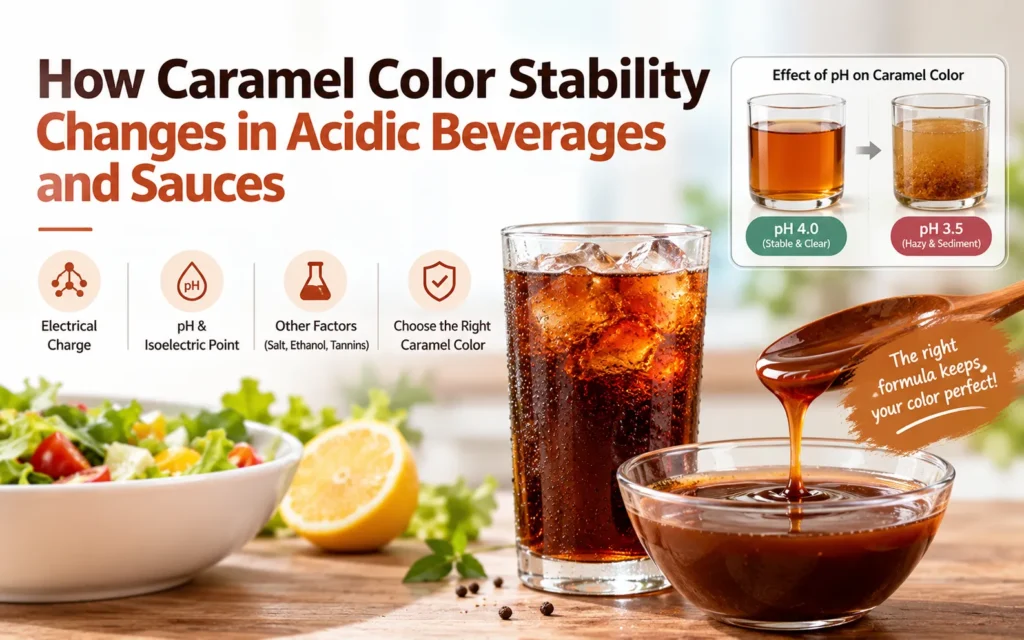
We have observed this tendency in the case of vinaigrette compositions that are on an early stage. A marvelous amber color at pH 4.0 can become a cloudy mess with sediment. This happens if the pH decreases to 3.5, thus, crossing the isoelectric point of a poorly chosen caramel. This is the first illustration of how caramel color stability changes in acidic beverages and sauces when science is not respected.
To solve this issue, you need first to reduce the pH. The acid can react with the caramel color and form an acid-resistant caramel color. Caramel colors are classified into four different classes. Each one comes with its own linear charge colloidal and acid stability traits.
| Caramel Class | E-Number | Reactants Used | Colloidal Charge | Typical Acid Stability (pH) |
|---|
| Class I | E150a | None (Plain) | Varies (Slightly -/+) | Generally > 3.0 |
| Class II | E150b | Sulfites | Negative | Generally > 3.0 |
| Class III | E150c | Ammonia | Positive | Good in specific applications (e.g., beer) |
| Class IV | E150d | Sulfites & Ammonia | Strongly Negative | Excellent (< 3.0) |
Caramel Class Selection for Your Acidic Application
Class IV Caramel: The Undisputed Ruler of Colas and Soft Drinks
The internal environment of a cola or carbonated soft drink is extremely acidic. It often has a pH value ranging from 2.5 to 3.5. Under these condition, the caramel color you should choose is the one that carrying the charge of +3.
Class IV (E150d) caramel color is the only one with the highest negative charge of -3. The strong repulsion between the particles thus created by this characteristic of Class IV ensures its complete dissolution in the medium. It is the one that adds the consumer favorite, stable brown color to soft drinks. A distinct find is the latest publication of the Caramel Color FAQ from industry experts in which Class IV is claimed to be the prevalent colorant. In fact, it is the indispensable digger for the proper construction of many global soft drink brands.
The Dilemma with Sauces, Dressings, and Marinades
Sauces and dressings form a complex problem. They add acids like vinegar or citric acid, to name a few. Also, they are high in salt and sometimes have alcohol. Each of these might make the caramel color of stability to change.
A negatively charged caramel will be the best recommendation for most acidic sauces. These are applied to BBQ sauces, teriyaki marinades, or vinaigrettes. A strong Class IV caramel is usually the best and most common choice.
The Development of Acid-Stable Class I Caramels
The increase in the “clean label” trend and the year 2026 leads to the feature of many developers using Class I (E150a) caramel more and more often. It includes only the two most basic components in the ingredient list. Yet, generally speaking, Class I caramels present a challenge in acidic conditions and will no longer be usable as a result of their precipitation.
The good news is that ingredient technology is not left behind. This article link highlights the immense progress made in the last few years with the development of acid-stable class one caramel colors. These caramels are specifically produced for the clean label developers that want them. They are also the ones that provide necessary performance. Such newly invented products can have stability even at a pH level of below 2.5. This is remarkable compared to the old Class I caramels that would lose stability at a pH level of just 4.5.
Other Stability Imposters: Issues Beyond Acidity
The initial move is to have a good knowledge of the pH level of your products. But the truth is that many other elements besides the acidic level could be the culprits leading to your color’s dissipation. A genuinely stable formula should be based on a comprehensive understanding of all component parts.
The Effect of Ionic Strength (Salt)
Considerable salt concentrations can destabilize the caramel color. The ions of the salt in the solution can disrupt and “coat” the repulsive forces on the caramel particles. This is possible even when the pH level is moderate. Reach this far it is the operational goal. The latter process is the basis for the clumping and precipitating of the particles.
Our experience with sodium-rich broths and sauces showed that even the strongest acid-stable caramel needs thorough testing. This kind of testing is for those which are used in making our High-Salt Dilute Authenticity Brew™. The high ionic strength from salt is one of the major contributors to the caramel color stability alterations. So, accounting for it is necessary.
The Influence of Alcohol
The stability of alcohol can also be subject to changes. Because of increased spirits, liqueurs, and specific flavor extracts, this is especially true. The alcohol could adjust the caramel particles’ solubility, which would then cause hazing.
Commonly utilized for this usage are specific “spirit-soluble” caramels. Caramels of this kind are generally of Class I or Class II. They are produced from raw materials that are compatible to the system where they will be installed. The caramels are manufactured specifically to be stable in high-proof alcohol environments.
Interaction with Other Ingredients (Tannins, Proteins)
Lastly, you should think of other reactive components that are present in your formula. Tannins are found in tea, coffee, and some fruit juices. They have a charge and can bond with the caramel color. The same phenomenon occurs with the proteins in dairy drinks or creamy sauces.
Caramel color is versatile and used across many top applications in beverages and sauces. It should be noted, however, that such versatility completely hinges on precise formulation. For instance, the interaction of a positive-charged caramel (Class III) with a negative-charged tannin results in precipitation. A negative-charged Class IV would be, therefore, a more appropriate choice.
A Practical 4-Step Guide to Selecting and Testing for Stability
Implement a theoretical approach with this easy, four-step process. This will make sure the color is stable on your next project.
Step 1: Define Your Product Matrix
Before you select a color, you must know your product inside and out. Create a technical checklist:
* What is my final product’s target pH?
* What is the pH of my concentrate (if applicable)?
* What is the salt concentration (%)?
* What is the alcohol by volume (%)?
* Are there other reactive ingredients (tannins, proteins)?
Step 2: Make Your Preliminary Selection
With the help of your answers from Step 1 and the caramel class table above, you can formally make an initial choice. For example: “The pH of my cola is 2.8 and it does not have salt and alcohol, so I will start testing the Class IV caramel.” Or, “My vinegar with clean ingredients is 3.5 pH, thus I am going to get a Class I caramel that is acid-stable.”
Step 3: Source High-Quality Samples
Work with an experienced supplier who provides the full technical support that you need. This consists of data sheets and expert suggestions. A suitable partner can often point out the best starting options based on your product matrix. For developers who need reliable and consistent results, especially in niche applications, working with a supplier who provides tailored solutions is very important. For instance, formulations such as Custom Caramel Color – Qianhe can be specifically designed to satisfy the pH and ionic strength requirements. This practically guarantees the success of the project right from the outset.
Step 4: Run a Simple Stability Test
This last step is too important to ever ignore. The simple benchtop test may help you escape big manufacture problem.
- Create a sample of your product base without the addition of any color.
- Add the caramel color at the desired dosage rate.
- Mix well and pour the ready product into transparent glass jars or bottles.
- Store one sample at normal temperature, one in the fridge, and one in a warm incubator (if available) to accelerate any possible reactions.
- The samples need to be checked at 24 hours, 48 hours, and one week. Look for any signs of hazing, sediment (such as a “ring” or dust at the bottom), or color fading when seen against a white background. The findings from this test are a true reflection of how the caramel color stability in your specific product changes.
FAQ: Your Caramel Color Stability Questions Answered
What kind of caramel color is suitable for carbonated drinks with very low pH, for example, colas?
Class IV (E150d) is the most widely used caramel color in high-acid beverages such as colas. The high negative colloidal charge that it has helps it maintain a good state in a pH level of 2.5 or lower. This prevents precipitation and hazing which are features associated with other classes.
I want a “clean label.” Is it possible to use Class I caramel in a sauce that is acidic?
Yes, but you need a specific and innovative recipe. The regular Class I (E150a) is not stable in acid and is likely to fail. You should look for a specifically developed “acid-stable Class I” that has’t been destroyed in the low-pH application is it meant to be. It has been specifically designed for this purpose while keeping its original characteristics unchanged.